a gas that exerts a pressure of 6.20 atm in a container with an unknown volume will exert a pressure of…
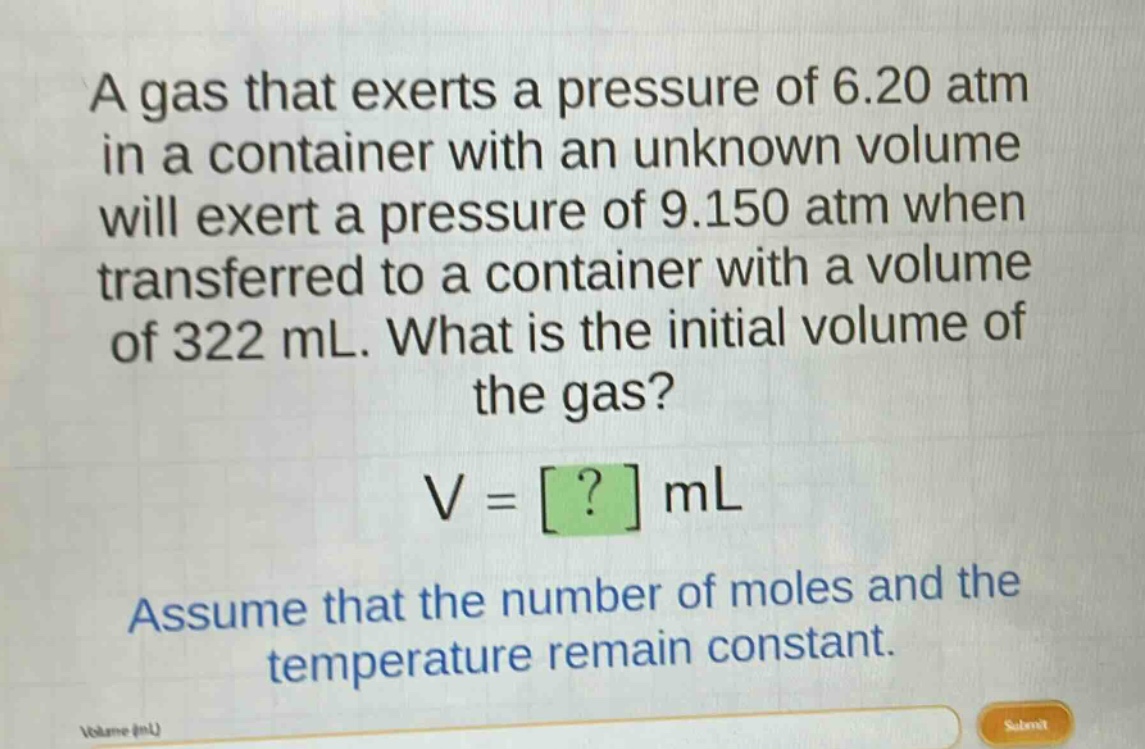
a gas that exerts a pressure of 6.20 atm in a container with an unknown volume will exert a pressure of 9.150 atm when transferred to a container with a volume of 322 ml. what is the initial volume of the gas?\nv = ? ml\nassume that the number of moles and the temperature remain constant.
Answer
Explanation:
Step1: Write down Boyle's Law formula
Boyle's Law is (P_1V_1 = P_2V_2), where (P_1) is the initial pressure, (V_1) is the initial volume, (P_2) is the final pressure, and (V_2) is the final volume.
Step2: Substitute the given values into the formula
We are given (P_1 = 6.20\space atm), (P_2=9.150\space atm), and (V_2 = 322\space mL). Plugging these into (P_1V_1 = P_2V_2) gives (6.20\times V_1=9.150\times322).
Step3: Solve for (V_1)
First, calculate (9.150\times322 = 2946.3). Then, (V_1=\frac{2946.3}{6.20}). [V_1 = 475.209677\approx475\space mL]
Answer:
(475\space mL)