in the graph you can observe the trends of boiling points for various families of compounds. for the red…
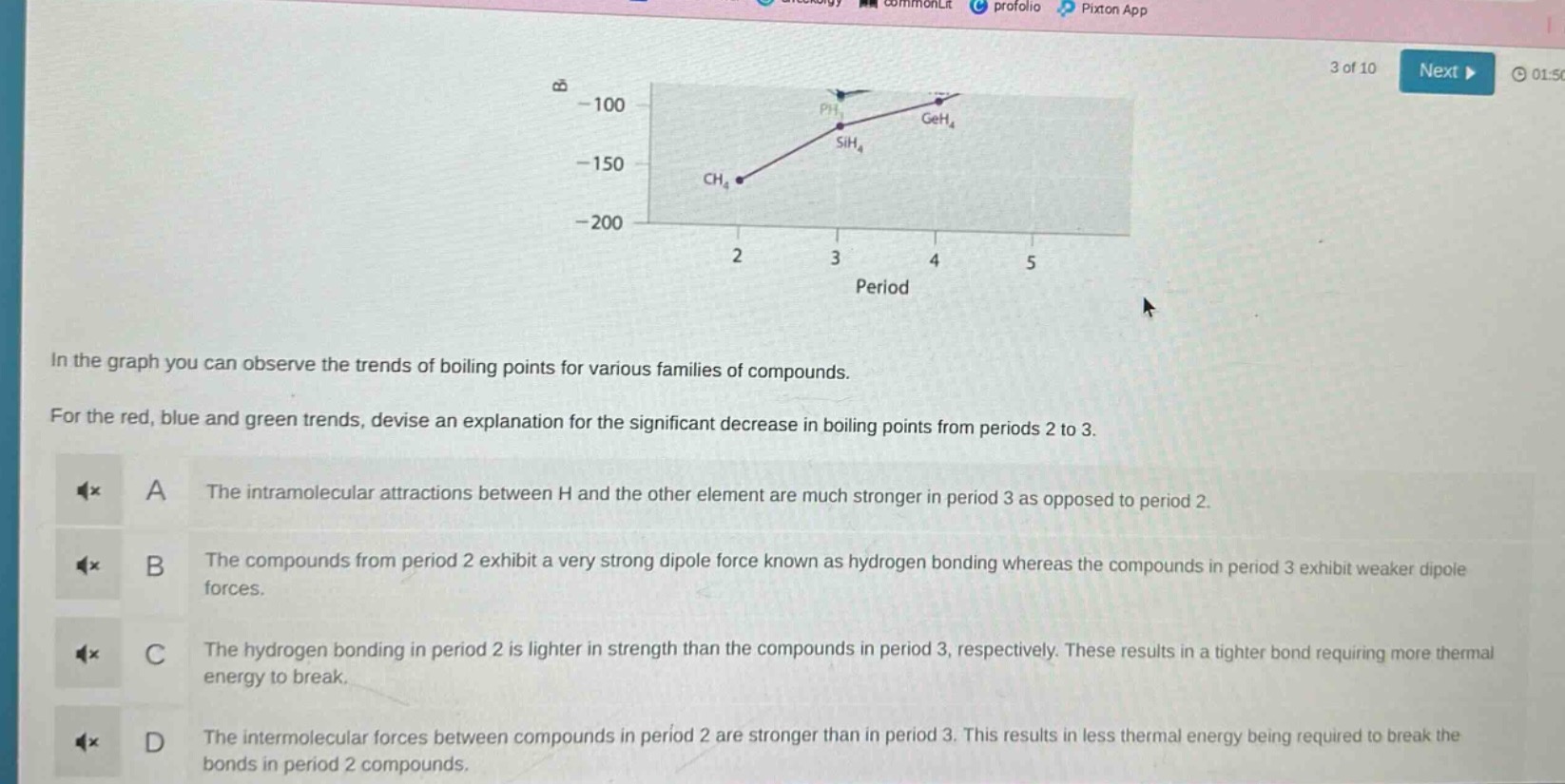
in the graph you can observe the trends of boiling points for various families of compounds. for the red, blue and green trends, devise an explanation for the significant decrease in boiling points from periods 2 to 3. a the intramolecular attractions between h and the other element are much stronger in period 3 as opposed to period 2. b the compounds from period 2 exhibit a very strong dipole force known as hydrogen bonding whereas the compounds in period 3 exhibit weaker dipole forces. c the hydrogen bonding in period 2 is lighter in strength than the compounds in period 3, respectively. these results in a tighter bond requiring more thermal energy to break. d the intermolecular forces between compounds in period 2 are stronger than in period 3. this results in less thermal energy being required to break the bonds in period 2 compounds.
Answer
Brief Explanations:
Hydrogen bonding is a very strong dipole - dipole force. Compounds in period 2 can exhibit hydrogen bonding (e.g., if the central atom is N, O, or F bonded to H), while compounds in period 3 usually have weaker dipole - dipole forces or only London dispersion forces. Stronger intermolecular forces like hydrogen bonding in period 2 compounds require more energy to break, resulting in higher boiling points compared to period 3 compounds with weaker forces.
Answer:
B. The compounds from period 2 exhibit a very strong dipole force known as hydrogen bonding whereas the compounds in period 3 exhibit weaker dipole forces.