a group of students are wandering around a room. when their teacher claps, the students sit down wherever…
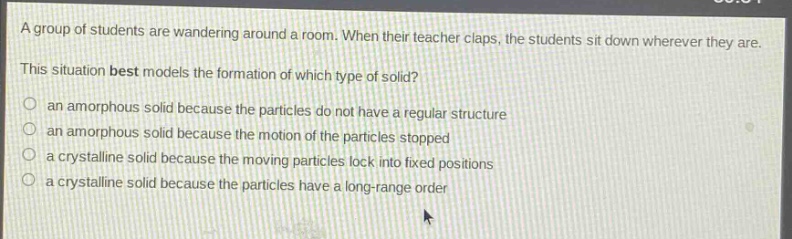
a group of students are wandering around a room. when their teacher claps, the students sit down wherever they are. this situation best models the formation of which type of solid?\n○ an amorphous solid because the particles do not have a regular structure\n○ an amorphous solid because the motion of the particles stopped\n○ a crystalline solid because the moving particles lock into fixed positions\n○ a crystalline solid because the particles have a long - range order
Answer
Brief Explanations:
In an amorphous solid, particles lack a regular, long - range ordered structure. When students sit down randomly where they are upon the teacher's clap, it's like particles in an amorphous solid not arranging in a regular pattern. In a crystalline solid, particles have a long - range order and lock into fixed positions in a regular way. Here, the random sitting of students is not a regular arrangement. Also, the stopping of motion is not the key characteristic to distinguish between amorphous and crystalline solids in this context.
Answer:
an amorphous solid because the particles do not have a regular structure