groups of students weighed three different samples of magnesium sulfate. the samples actually weigh 5.25…
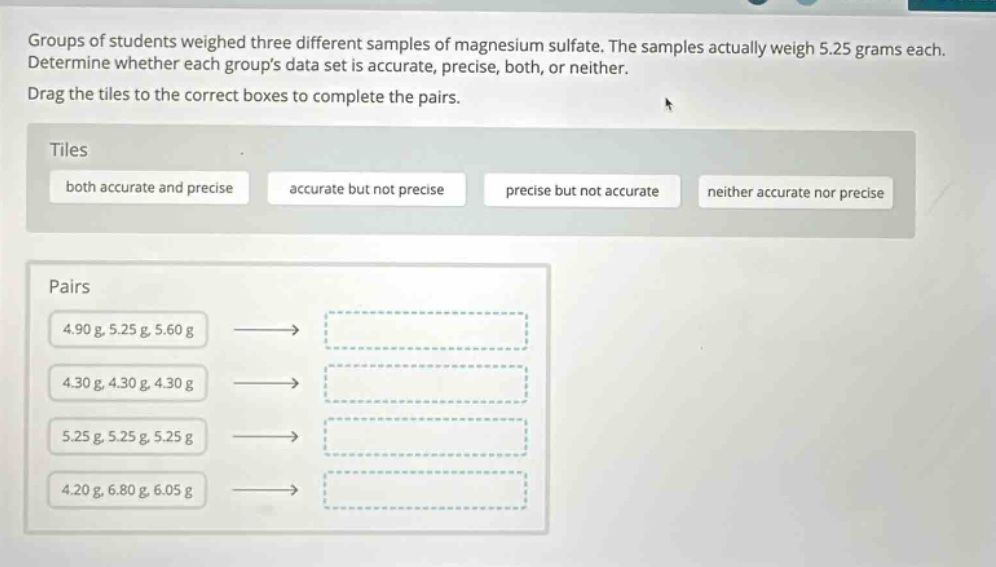
groups of students weighed three different samples of magnesium sulfate. the samples actually weigh 5.25 grams each. determine whether each groups data set is accurate, precise, both, or neither. drag the tiles to the correct boxes to complete the pairs. tiles both accurate and precise accurate but not precise precise but not accurate neither accurate nor precise pairs 4.90 g, 5.25 g, 5.60 g 4.30 g, 4.30 g, 4.30 g 5.25 g, 5.25 g, 5.25 g 4.20 g, 6.80 g, 6.05 g
Answer
Explanation:
Step1: Define accuracy and precision
Accuracy is closeness to true - value. Precision is closeness of measurements to each other.
Step2: Analyze 4.90 g, 5.25 g, 5.60 g
Values are not close to each other (not precise) and some are close to 5.25 g (accurate). So, accurate but not precise.
Step3: Analyze 4.30 g, 4.30 g, 4.30 g
Values are close to each other (precise) but far from 5.25 g (not accurate). So, precise but not accurate.
Step4: Analyze 5.25 g, 5.25 g, 5.25 g
Values are close to each other (precise) and equal to true - value (accurate). So, both accurate and precise.
Step5: Analyze 4.20 g, 6.80 g, 6.05 g
Values are not close to each other (not precise) and not close to 5.25 g (not accurate). So, neither accurate nor precise.
Answer:
4.90 g, 5.25 g, 5.60 g → accurate but not precise 4.30 g, 4.30 g, 4.30 g → precise but not accurate 5.25 g, 5.25 g, 5.25 g → both accurate and precise 4.20 g, 6.80 g, 6.05 g → neither accurate nor precise