guided practice on molarity, molality, and dilution\n1. 6.0 moles of koh are dissolved in 15.5 l of acetone…
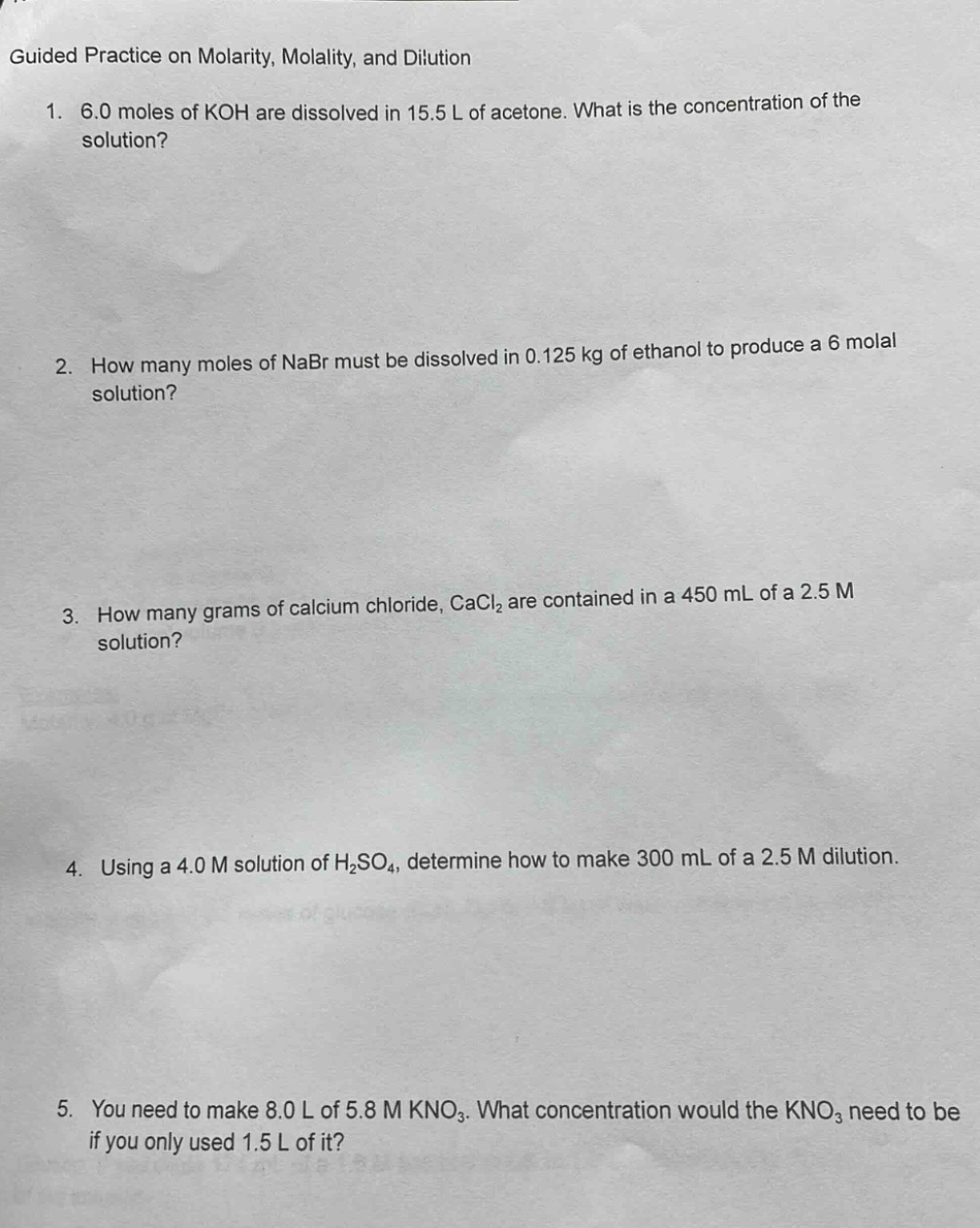
guided practice on molarity, molality, and dilution\n1. 6.0 moles of koh are dissolved in 15.5 l of acetone. what is the concentration of the solution?\n2. how many moles of nabr must be dissolved in 0.125 kg of ethanol to produce a 6 molal solution?\n3. how many grams of calcium chloride, cacl₂ are contained in a 450 ml of a 2.5 m solution?\n4. using a 4.0 m solution of h₂so₄, determine how to make 300 ml of a 2.5 m dilution.\n5. you need to make 8.0 l of 5.8 m kno₃. what concentration would the kno₃ need to be if you only used 1.5 l of it?
Answer
Explanation:
Step1: Recall molarity formula
Molarity ($M$) = $\frac{n}{V}$, where $n$ is the number of moles and $V$ is the volume of the solution in liters. Given $n = 6.0$ moles of $KOH$ and $V=15.5$ L of acetone. $M=\frac{6.0}{15.5}\approx 0.39$ M
Step2: Recall molality formula
Molality ($m$) = $\frac{n}{m_{solvent}}$, where $n$ is the number of moles of solute and $m_{solvent}$ is the mass of the solvent in kg. Given $m = 6$ molal and $m_{solvent}=0.125$ kg of ethanol. $n=m\times m_{solvent}=6\times0.125 = 0.75$ moles of $NaBr$
Step3: First find moles of $CaCl_2$
Using $n = M\times V$. Given $M = 2.5$ M and $V = 450$ mL = $0.45$ L. $n=2.5\times0.45 = 1.125$ moles of $CaCl_2$ Then find mass of $CaCl_2$. Molar - mass of $CaCl_2$: $M_{CaCl_2}=40.08+(2\times35.45)=110.98$ g/mol $m=n\times M_{CaCl_2}=1.125\times110.98\approx124$ g
Step4: Use dilution formula $M_1V_1 = M_2V_2$
Given $M_1 = 4.0$ M, $M_2 = 2.5$ M and $V_2 = 300$ mL. $V_1=\frac{M_2V_2}{M_1}=\frac{2.5\times300}{4.0}=187.5$ mL So, take 187.5 mL of the 4.0 M $H_2SO_4$ solution and add $(300 - 187.5)=112.5$ mL of water.
Step5: Use $n_1=n_2$ (moles before and after dilution are the same), so $M_1V_1 = M_2V_2$
Given $V_1 = 1.5$ L, $V_2 = 8.0$ L and $M_2 = 5.8$ M. $M_1=\frac{M_2V_2}{V_1}=\frac{5.8\times8.0}{1.5}\approx30.9$ M
Answer:
- The concentration of the solution is approximately 0.39 M.
- 0.75 moles of $NaBr$ must be dissolved.
- Approximately 124 g of $CaCl_2$ are contained.
- Take 187.5 mL of the 4.0 M $H_2SO_4$ solution and add 112.5 mL of water.
- The concentration of the $KNO_3$ would need to be approximately 30.9 M.