h2(g) + i2(g) ⇌ 2hi(g) δh > 0\nwhich of the following changes to the equilibrium system represented above…
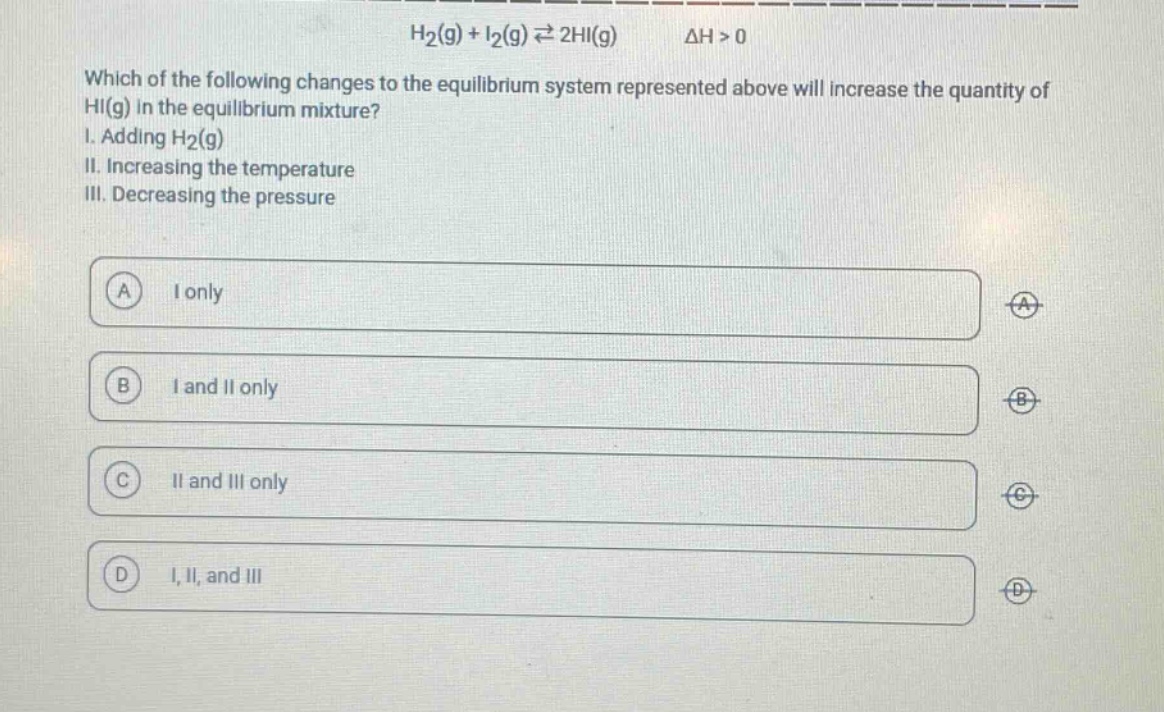
h2(g) + i2(g) ⇌ 2hi(g) δh > 0\nwhich of the following changes to the equilibrium system represented above will increase the quantity of hi(g) in the equilibrium mixture?\ni. adding h2(g)\nii. increasing the temperature\niii. decreasing the pressure\na i only\nb i and ii only\nc ii and iii only\nd i, ii, and iii
Answer
Explanation:
Step1: Analyze adding H₂(g)
According to Le - Chatelier's principle, adding a reactant (H₂(g)) shifts the equilibrium to the right, increasing the quantity of HI(g).
Step2: Analyze increasing temperature
Since $\Delta H>0$ (endothermic reaction), increasing the temperature favors the forward endothermic reaction, shifting the equilibrium to the right and increasing the quantity of HI(g).
Step3: Analyze decreasing pressure
The reaction has equal number of moles of gas on both sides ($n_{reactants}=1 + 1=2$, $n_{products}=2$). Decreasing the pressure has no effect on the equilibrium position as there is no change in the number of moles of gas.
Answer:
B. I and II only