the haber process can be used to produce ammonia (nh₃) from hydrogen gas (h₂) and nitrogen gas (n₂). the…
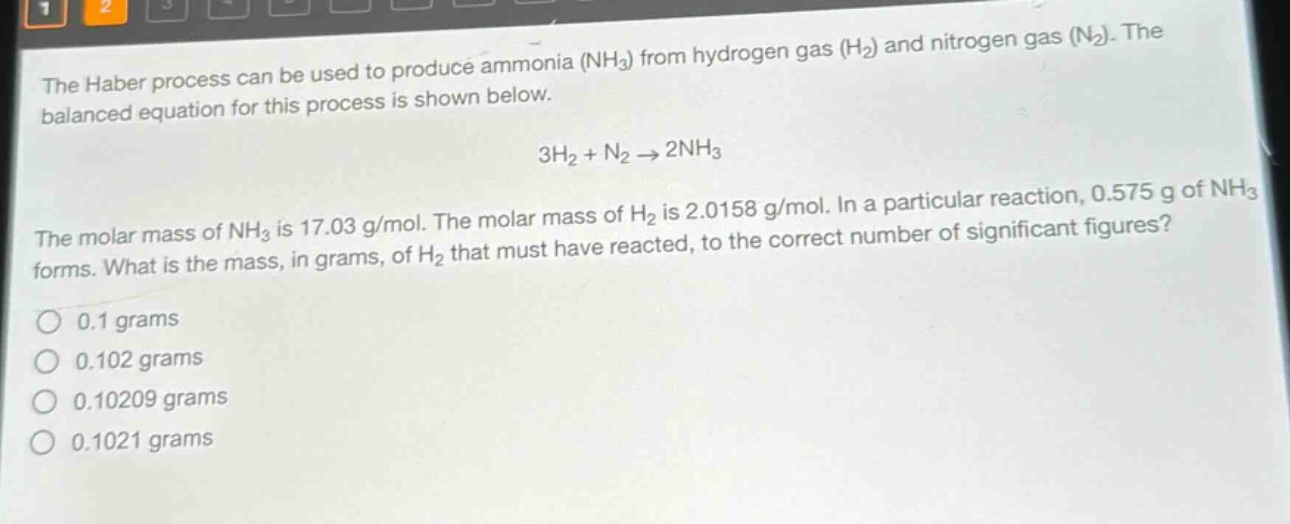
the haber process can be used to produce ammonia (nh₃) from hydrogen gas (h₂) and nitrogen gas (n₂). the balanced equation for this process is shown below.\n3h₂ + n₂ → 2nh₃\nthe molar mass of nh₃ is 17.03 g/mol. the molar mass of h₂ is 2.0158 g/mol. in a particular reaction, 0.575 g of nh₃ forms. what is the mass, in grams, of h₂ that must have reacted, to the correct number of significant figures?\no 0.1 grams\no 0.102 grams\no 0.10209 grams\no 0.1021 grams
Answer
Explanation:
Step1: Calculate moles of $NH_3$
Use the formula $n=\frac{m}{M}$, where $n$ is moles, $m$ is mass and $M$ is molar - mass. Given $m = 0.575\ g$ and $M = 17.03\ g/mol$ of $NH_3$. $n_{NH_3}=\frac{0.575\ g}{17.03\ g/mol}\approx0.0338\ mol$
Step2: Determine moles of $H_2$ from the stoichiometry
From the balanced equation $3H_2 + N_2\rightarrow2NH_3$, the mole - ratio of $H_2$ to $NH_3$ is $\frac{n_{H_2}}{n_{NH_3}}=\frac{3}{2}$. So $n_{H_2}=\frac{3}{2}n_{NH_3}$. $n_{H_2}=\frac{3}{2}\times0.0338\ mol = 0.0507\ mol$
Step3: Calculate mass of $H_2$
Use the formula $m = n\times M$. Given $n = 0.0507\ mol$ and $M = 2.0158\ g/mol$ of $H_2$. $m_{H_2}=0.0507\ mol\times2.0158\ g/mol\approx0.102\ g$
Answer:
0.102 grams