the half - life of iodine - 131 is 8 days. chan hee examines two samples of iodine - 131. sample 1: 10 g…
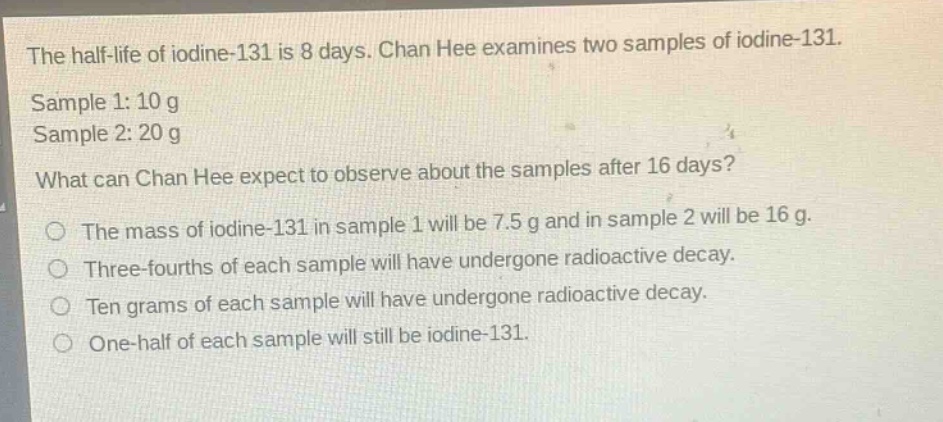
the half - life of iodine - 131 is 8 days. chan hee examines two samples of iodine - 131. sample 1: 10 g sample 2: 20 g what can chan hee expect to observe about the samples after 16 days? the mass of iodine - 131 in sample 1 will be 7.5 g and in sample 2 will be 16 g. three - fourths of each sample will have undergone radioactive decay. ten grams of each sample will have undergone radioactive decay. one - half of each sample will still be iodine - 131.
Answer
Explanation:
Step1: Calculate number of half - lives
The half - life of iodine - 131 is 8 days and the time elapsed is 16 days. The number of half - lives $n=\frac{16}{8}=2$.
Step2: Calculate remaining mass for sample 1
The initial mass of sample 1 is $m_0 = 10$ g. Using the formula $m=m_0\times(\frac{1}{2})^n$, we have $m = 10\times(\frac{1}{2})^2=10\times\frac{1}{4}=2.5$ g. The mass decayed is $10 - 2.5=7.5$ g.
Step3: Calculate remaining mass for sample 2
The initial mass of sample 2 is $m_0 = 20$ g. Using the formula $m=m_0\times(\frac{1}{2})^n$, we have $m = 20\times(\frac{1}{2})^2=20\times\frac{1}{4}=5$ g. The mass decayed is $20 - 5 = 15$ g.
Step4: Analyze decay fraction
The fraction of the sample remaining after $n = 2$ half - lives is $(\frac{1}{2})^2=\frac{1}{4}$. So the fraction that has decayed is $1-\frac{1}{4}=\frac{3}{4}$.
Answer:
B. Three - fourths of each sample will have undergone radioactive decay.