which half - reaction correctly describes an oxidation?\nca(s)+2e^−→ca^{2 + }(aq)\nbr2 + 2e^−→2br^−\nna^{+}(a…
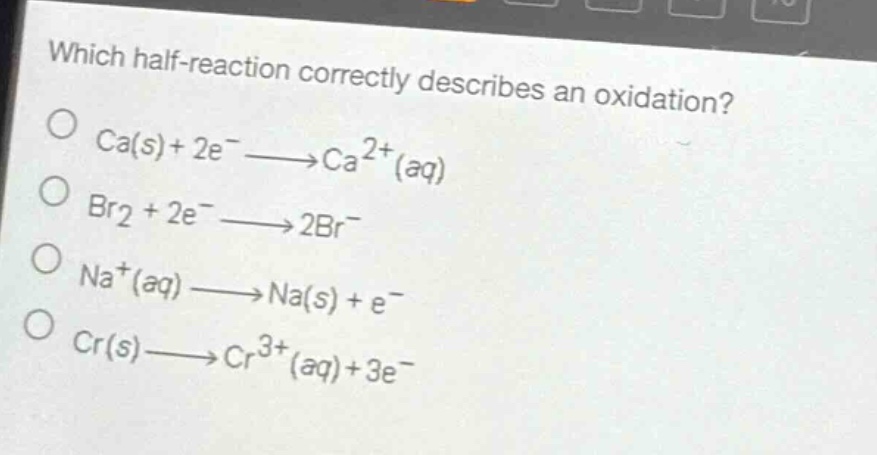
which half - reaction correctly describes an oxidation?\nca(s)+2e^−→ca^{2 + }(aq)\nbr2 + 2e^−→2br^−\nna^{+}(aq)→na(s)+e^−\ncr(s)→cr^{3 + }(aq)+3e^−
Answer
Explanation:
Step1: Recall oxidation definition
Oxidation is the loss of electrons.
Step2: Analyze each option
- For $\text{Ca}(s)+ 2e^-\longrightarrow\text{Ca}^{2 +}(aq)$, calcium gains 2 electrons, it's reduction.
- For $\text{Br}_2 + 2e^-\longrightarrow2\text{Br}^-$, bromine gains 2 electrons, it's reduction.
- For $\text{Na}^+(aq)\longrightarrow\text{Na}(s)+e^-$, sodium ion gains 1 electron, it's reduction.
- For $\text{Cr}(s)\longrightarrow\text{Cr}^{3+}(aq)+3e^-$, chromium loses 3 electrons, it's oxidation.
Answer:
$\text{Cr}(s)\longrightarrow\text{Cr}^{3+}(aq)+3e^-$