when a hammer strikes a compound formed by covalent bonds, what will most likely happen to the compound?\no…
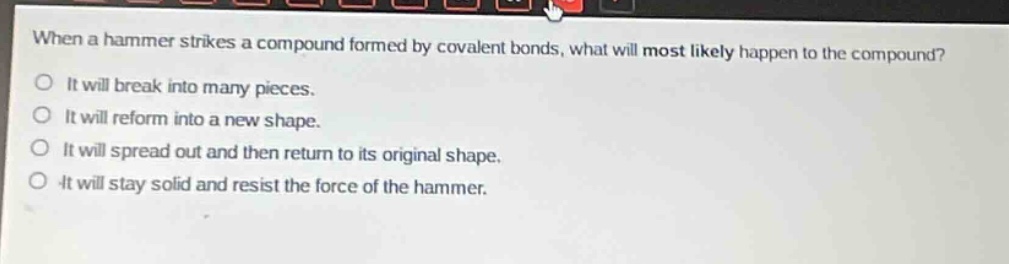
when a hammer strikes a compound formed by covalent bonds, what will most likely happen to the compound?\no it will break into many pieces.\no it will reform into a new shape.\no it will spread out and then return to its original shape.\no it will stay solid and resist the force of the hammer.
Answer
Brief Explanations:
Covalent compounds are generally brittle. When a force (like from a hammer strike) is applied, the lack of free - moving ions (as in ionic compounds) to redistribute the force leads to the compound breaking. The other options are not characteristic of covalent compounds. For example, metals (which are not covalent compounds) can reform into new shapes (due to metallic bonding allowing for malleability), substances with elastic properties (not typical of covalent compounds) can spread out and return to shape, and ionic compounds (with strong electrostatic forces in a lattice) can sometimes resist forces better in a different way than covalent compounds.
Answer:
It will break into many pieces.