a. what happened to the litmus paper when you placed a drop of acid on it? could you use litmus paper to…
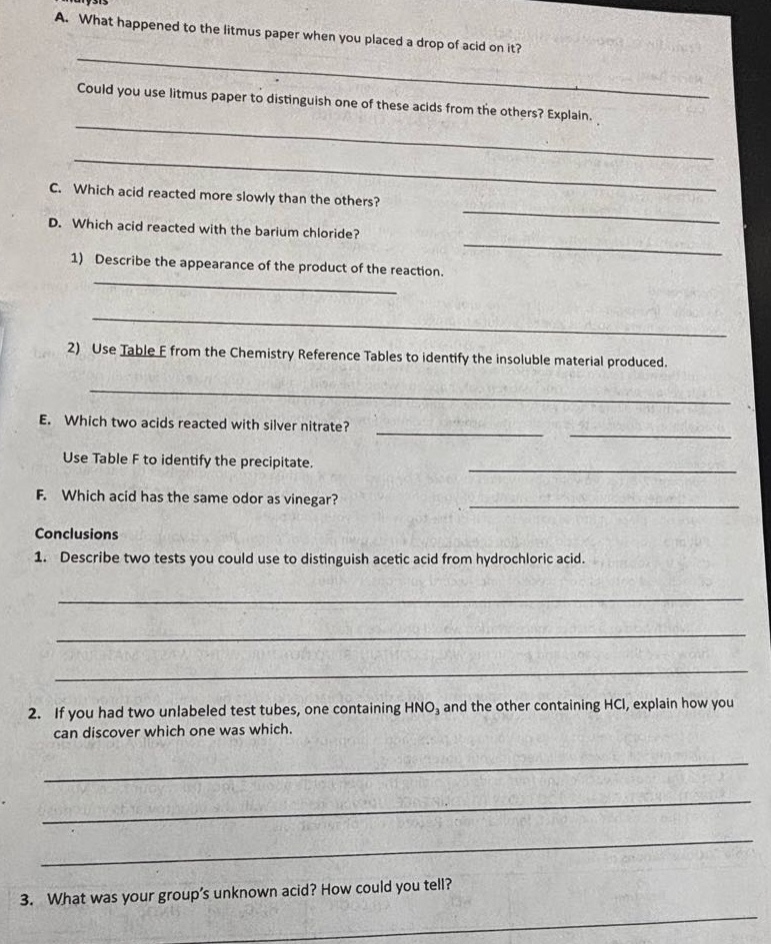
a. what happened to the litmus paper when you placed a drop of acid on it? could you use litmus paper to distinguish one of these acids from the others? explain. c. which acid reacted more slowly than the others? d. which acid reacted with the barium chloride? 1) describe the appearance of the product of the reaction. 2) use table f from the chemistry reference tables to identify the insoluble material produced. e. which two acids reacted with silver nitrate? use table f to identify the precipitate. f. which acid has the same odor as vinegar? conclusions 1. describe two tests you could use to distinguish acetic acid from hydrochloric acid. 2. if you had two unlabeled test tubes, one containing hno3 and the other containing hcl, explain how you can discover which one was which. 3. what was your group’s unknown acid? how could you tell?
Answer
Explanation:
Step1: Acid - litmus paper reaction
Acids turn blue litmus paper red. So, when a drop of acid is placed on blue litmus paper, it turns red. But litmus paper cannot distinguish between different acids as all acids show acidic properties and turn blue litmus red.
Step2: Acid reaction rate comparison
Without specific information about the acids in question, we cannot determine which acid reacted more slowly than the others.
Step3: Acid - barium chloride reaction
Sulfuric acid ($H_2SO_4$) reacts with barium chloride ($BaCl_2$) to form a white precipitate of barium sulfate ($BaSO_4$). According to Table F in Chemistry Reference Tables, barium sulfate is insoluble. The appearance of the product is a white solid precipitate in the solution.
Step4: Acid - silver nitrate reaction
Hydrochloric acid ($HCl$) and hydrobromic acid ($HBr$) react with silver nitrate ($AgNO_3$). Hydrochloric acid forms a white precipitate of silver chloride ($AgCl$) and hydrobromic acid forms a cream - colored precipitate of silver bromide ($AgBr$). Using Table F, we can identify these as insoluble precipitates.
Step5: Acid with vinegar - like odor
Acetic acid has a similar odor to vinegar as vinegar is an aqueous solution of acetic acid.
Step6: Distinguishing acetic and hydrochloric acid
One test is the odor test. Acetic acid has a vinegar - like odor while hydrochloric acid has a pungent, sharp odor. Another test is to react them with silver nitrate. Hydrochloric acid will form a white precipitate of silver chloride while acetic acid will not form a precipitate with silver nitrate.
Step7: Distinguishing $HNO_3$ and $HCl$
Add silver nitrate solution. Hydrochloric acid will form a white precipitate of silver chloride ($AgCl$) while nitric acid will not form a precipitate with silver nitrate.
Step8: Identifying unknown acid
Without specific data about the unknown acid's reactions, we cannot determine what the unknown acid is. We would need to look at its reactions with various reagents (like those in the previous questions) and compare with known acid - reaction patterns.
Answer:
A. Blue litmus paper turns red; No, litmus paper cannot distinguish between different acids as all acids turn blue litmus red. C. Cannot be determined without specific acid information. D. Sulfuric acid; 1) White solid precipitate in solution; 2) Barium sulfate ($BaSO_4$). E. Hydrochloric acid and hydrobromic acid; Silver chloride ($AgCl$) and silver bromide ($AgBr$) respectively. F. Acetic acid. Conclusions 1: Odor test (acetic acid has vinegar - like odor, hydrochloric acid has pungent odor); Reaction with silver nitrate (hydrochloric acid forms white precipitate, acetic acid does not). Conclusions 2: Add silver nitrate solution. Hydrochloric acid forms white precipitate, nitric acid does not. Conclusions 3: Cannot be determined without specific reaction data about the unknown acid.