what happens when you heat a solid? heating a substance increases its thermal energy. when the particles in…
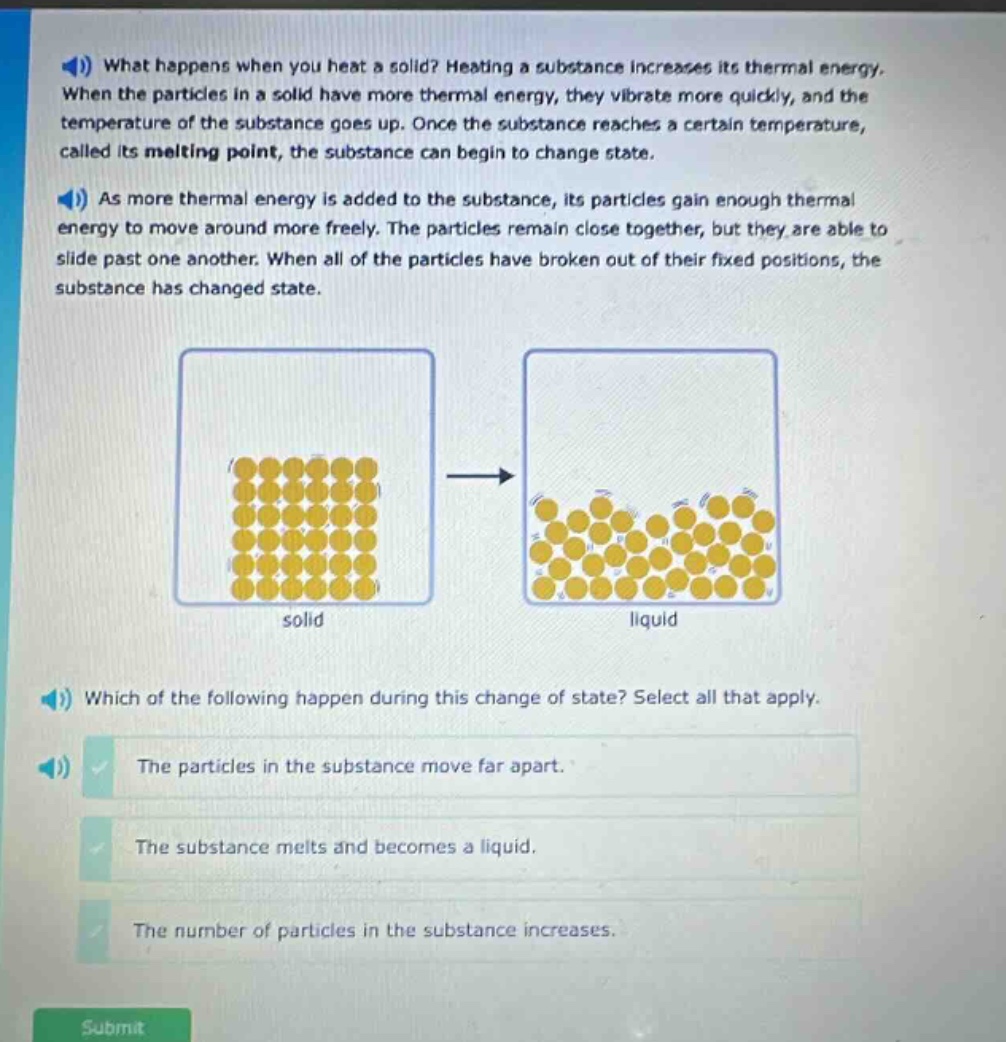
what happens when you heat a solid? heating a substance increases its thermal energy. when the particles in a solid have more thermal energy, they vibrate more quickly, and the temperature of the substance goes up. once the substance reaches a certain temperature, called its melting point, the substance can begin to change state. as more thermal energy is added to the substance, its particles gain enough thermal energy to move around more freely. the particles remain close together, but they are able to slide past one another. when all of the particles have broken out of their fixed positions, the substance has changed state. which of the following happen during this change of state? select all that apply. the particles in the substance move far apart. the substance melts and becomes a liquid. the number of particles in the substance increases.
Answer
Answer:
The substance melts and becomes a liquid.
Brief Explanations:
When a solid reaches its melting - point and enough thermal energy is added, it changes state to a liquid. The particles in a solid - to - liquid phase change do not move far apart (they remain close in a liquid) and the number of particles does not increase as it is a physical state change, not a chemical reaction that would create or destroy particles.