hesss law is also known as hesss law of constant heat summation, and our model gives us a good idea of what…
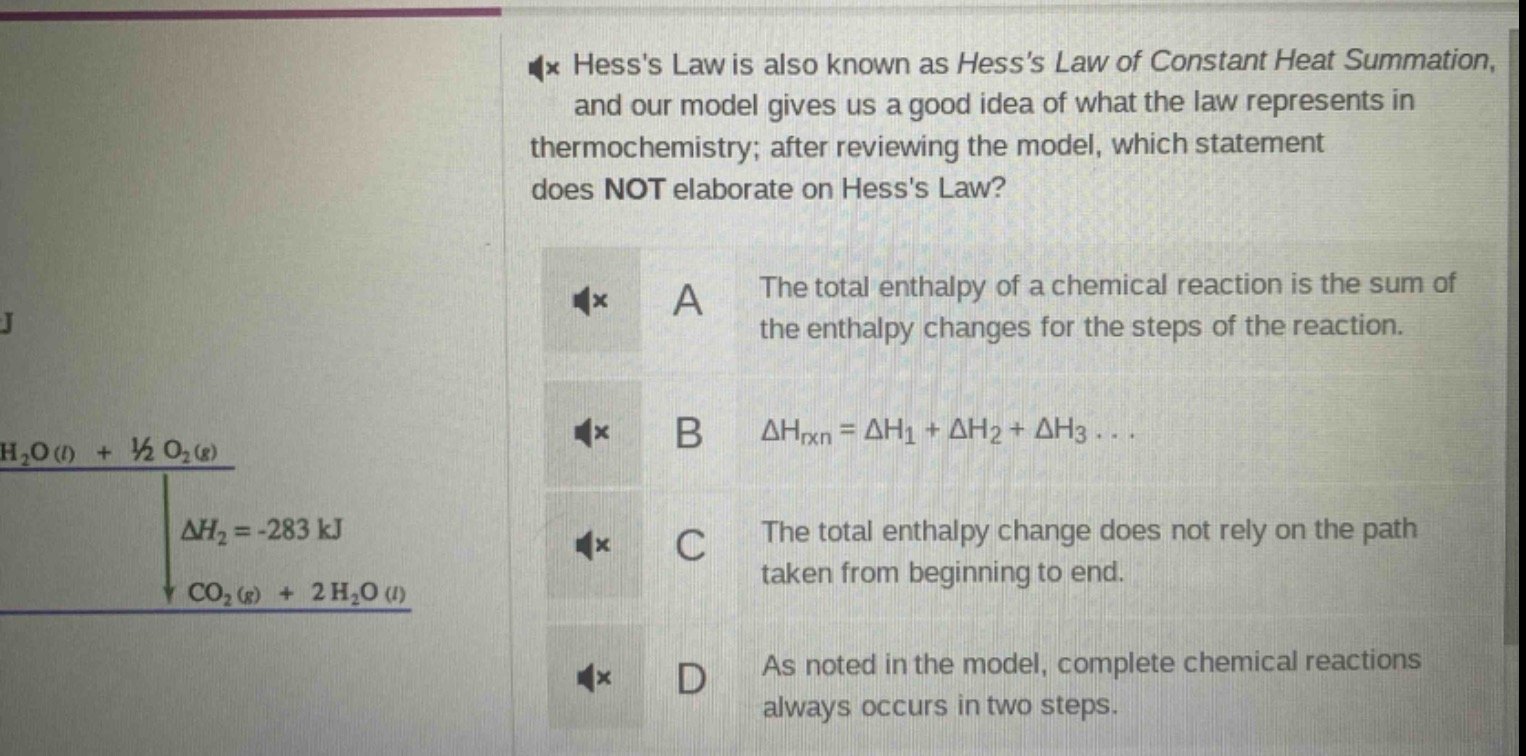
hesss law is also known as hesss law of constant heat summation, and our model gives us a good idea of what the law represents in thermochemistry; after reviewing the model, which statement does not elaborate on hesss law? a the total enthalpy of a chemical reaction is the sum of the enthalpy changes for the steps of the reaction. b $delta h_{rxn}=delta h_1+delta h_2+delta h_3...$ c the total enthalpy change does not rely on the path taken from beginning to end. d as noted in the model, complete chemical reactions always occurs in two steps.
Answer
Brief Explanations:
Hess's Law states that the total enthalpy change of a reaction is the sum of the enthalpy changes of its individual steps and is independent of the reaction - path. Option A describes the sum of enthalpy changes for reaction steps. Option B is the mathematical representation of Hess's Law. Option C emphasizes path - independence. Option D is incorrect because complete chemical reactions do not always occur in two steps and this has nothing to do with Hess's Law.
Answer:
D. As noted in the model, complete chemical reactions always occurs in two steps.