hf (hydrogen fluoride) becomes a gas at a higher temperature than does hcl (hydrogen chloride). this is…
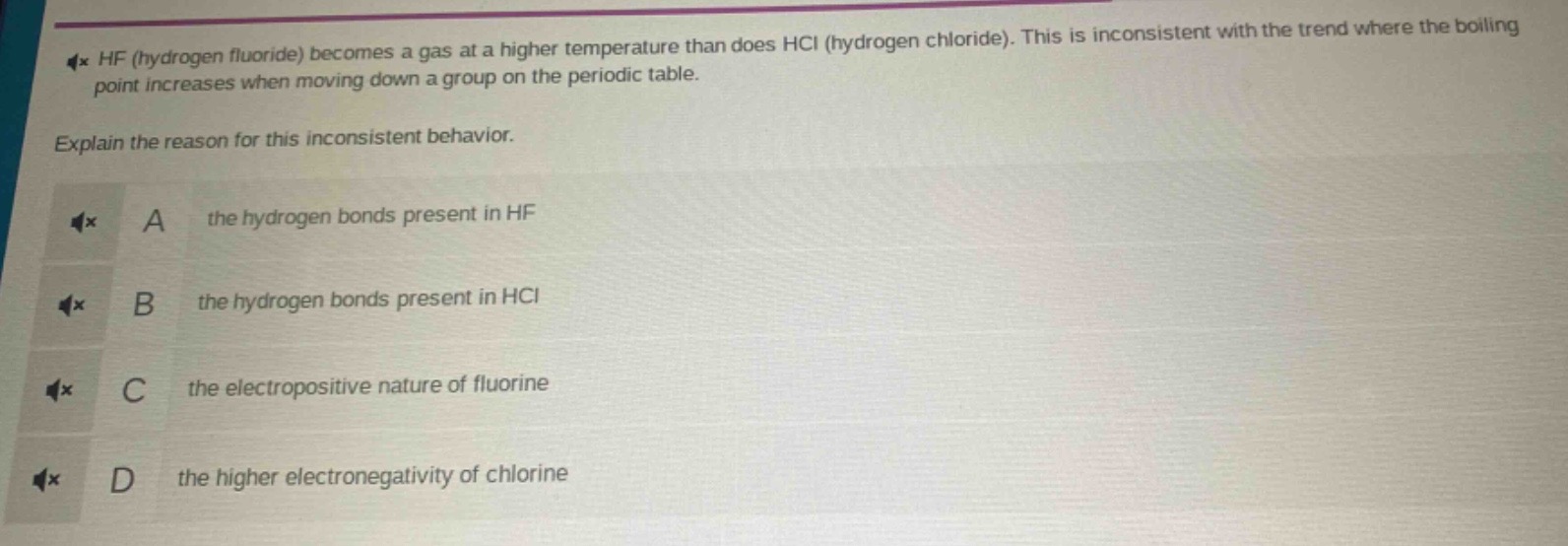
hf (hydrogen fluoride) becomes a gas at a higher temperature than does hcl (hydrogen chloride). this is inconsistent with the trend where the boiling point increases when moving down a group on the periodic table. explain the reason for this inconsistent behavior. a the hydrogen bonds present in hf b the hydrogen bonds present in hcl c the electropositive nature of fluorine d the higher electronegativity of chlorine
Answer
Brief Explanations:
Hydrogen fluoride (HF) has hydrogen - bonding due to the high electronegativity of fluorine. Hydrogen - bonding is a stronger intermolecular force compared to the dipole - dipole forces in HCl. Stronger intermolecular forces require more energy to break, resulting in a higher boiling point for HF despite the general trend of increasing boiling points down a group. HCl does not have hydrogen - bonding. Fluorine is highly electronegative, not electropositive. Chlorine has lower electronegativity than fluorine.
Answer:
A. the hydrogen bonds present in HF