homework 1:\n1. who found the electron and proposed the \plum pudding\ model of atoms?\n2. who found the…
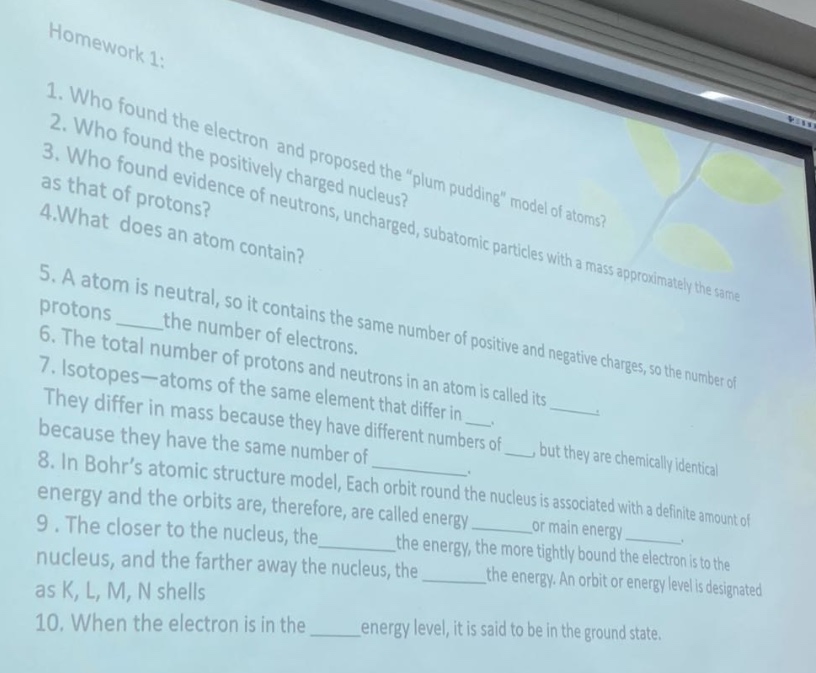
homework 1:\n1. who found the electron and proposed the \plum pudding\ model of atoms?\n2. who found the positively charged nucleus?\n3. who found evidence of neutrons, uncharged, subatomic particles with a mass approximately the same as that of protons?\n4.what does an atom contain?\n5. a atom is neutral, so it contains the same number of positive and negative charges, so the number of protons ____the number of electrons.\n6. the total number of protons and neutrons in an atom is called its ____.\n7. isotopes—atoms of the same element that differ in mass because they have different numbers of ____, but they are chemically identical because they have the same number of ____.\n8. in bohr’s atomic structure model, each orbit round the nucleus is associated with a definite amount of energy and the orbits are, therefore, are called energy ____or main energy ____.\n9. the closer to the nucleus, the____the energy, the more tightly bound the electron is to the nucleus, and the farther away the nucleus, the ____the energy. an orbit or energy level is designated as k, l, m, n shells\n10. when the electron is in the ____energy level, it is said to be in the ground state.
Answer
Brief Explanations:
- J. J. Thomson found the electron and proposed the "plum - pudding" model of atoms. Ernest Rutherford found evidence of the nucleus. James Chadwick discovered neutrons. Eugen Goldstein is credited with the discovery of protons.
- An atom contains protons, neutrons, and electrons.
- Since an atom is neutral, the number of protons equals the number of electrons.
- The total number of protons and neutrons in an atom is called its mass number.
- Isotopes are atoms of the same element that differ in mass because they have different numbers of neutrons but the same number of protons.
- In Bohr’s atomic structure model, each orbit round the nucleus is associated with a definite amount of energy and the orbits are called energy levels or main energy shells.
- The closer to the nucleus, the lower the energy. The farther away from the nucleus, the higher the energy.
- When the electron is in the lowest energy level, it is said to be in the ground state.
Answer:
- J. J. Thomson (electron and plum - pudding model), Ernest Rutherford (nucleus), James Chadwick (neutrons), Eugen Goldstein (protons)
- Protons, neutrons, electrons
- equals
- mass number
- neutrons, protons
- levels, shells
- lower, higher
- lowest