hydrogen reacts with chlorine to form hydrogen chloride (hcl (g), $delta h_f=-92.3$ kj/mol) according to the…
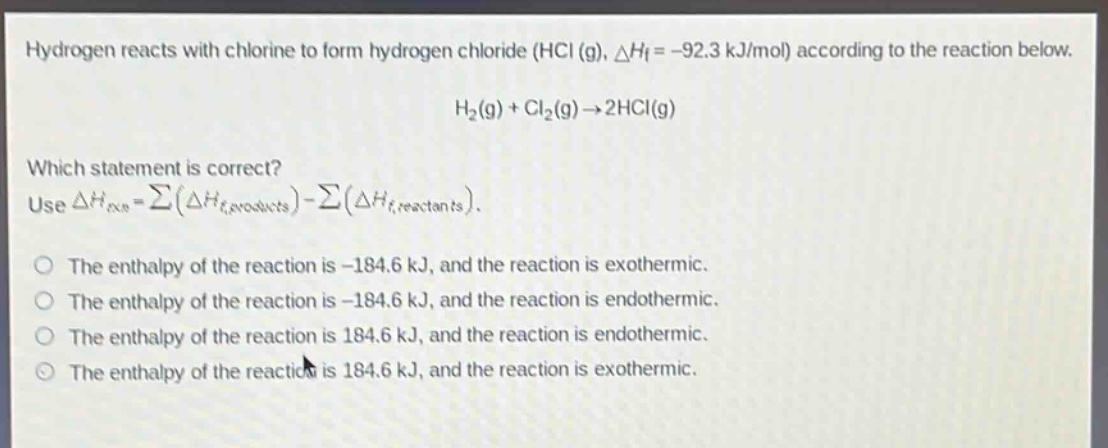
hydrogen reacts with chlorine to form hydrogen chloride (hcl (g), $delta h_f=-92.3$ kj/mol) according to the reaction below.\n\n$h_2(g)+cl_2(g)\rightarrow2hcl(g)$\n\nwhich statement is correct?\nuse $delta h_{rxn}=sum(delta h_{f,products})-sum(delta h_{f,reactants})$.\n\nthe enthalpy of the reaction is -184.6 kj, and the reaction is exothermic.\nthe enthalpy of the reaction is -184.6 kj, and the reaction is endothermic.\nthe enthalpy of the reaction is 184.6 kj, and the reaction is endothermic.\nthe enthalpy of the reaction is 184.6 kj, and the reaction is exothermic.
Answer
Explanation:
Step1: Identificar los ΔHf de productos y reactivos
Los ΔHf de H₂(g) y Cl₂(g) son 0 kJ/mol (por ser sustancias elementales en su estado estándar). El ΔHf de HCl(g) es -92.3 kJ/mol. Hay 2 moles de HCl(g) como producto.
Step2: Calcular la entalpía de reacción
Usando la fórmula $\Delta H_{rxn}=\sum(\Delta H_{f,products})-\sum(\Delta H_{f,reactants})$, tenemos $\Delta H_{rxn} = 2\times(- 92.3)- (0 + 0)=-184.6$ kJ.
Step3: Determinar si es exotérmica o endotérmica
Como $\Delta H_{rxn}<0$, la reacción libera calor y es exotérmica.
Answer:
The enthalpy of the reaction is -184.6 kJ, and the reaction is exothermic.