hydrogen reacts with chlorine to form hydrogen chloride (hcl (g), $delta h_f=-92.3$ kj/mol) according to the…
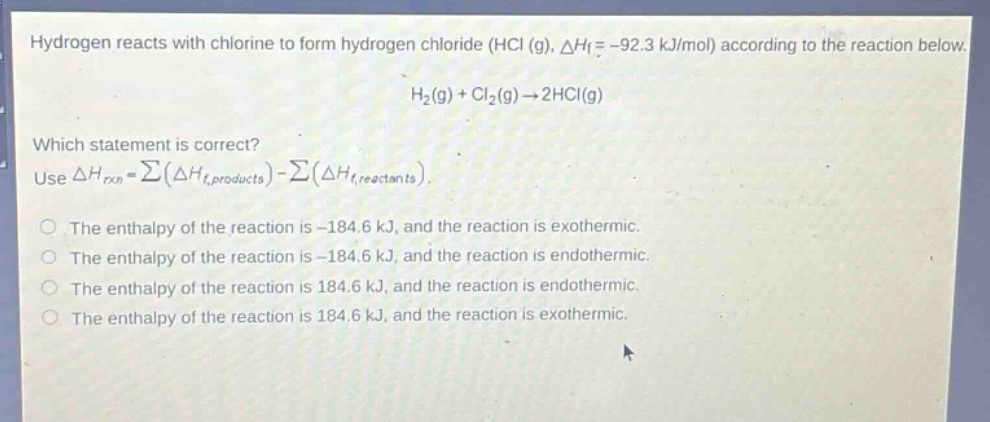
hydrogen reacts with chlorine to form hydrogen chloride (hcl (g), $delta h_f=-92.3$ kj/mol) according to the reaction below.\n$h_2(g)+cl_2(g)\rightarrow2hcl(g)$\nwhich statement is correct?\nuse $delta h_{rxn}=sum(delta h_{f,products})-sum(delta h_{f,reactants})$.\nthe enthalpy of the reaction is -184.6 kj, and the reaction is exothermic.\nthe enthalpy of the reaction is -184.6 kj, and the reaction is endothermic.\nthe enthalpy of the reaction is 184.6 kj, and the reaction is endothermic.\nthe enthalpy of the reaction is 184.6 kj, and the reaction is exothermic.
Answer
Explanation:
Step1: Identify reactants and products
Reactants: $H_2(g)$ and $Cl_2(g)$ with $\Delta H_f = 0$ kJ/mol (standard - state elements). Product: $2HCl(g)$ with $\Delta H_f=-92.3$ kJ/mol.
Step2: Calculate $\Delta H_{rxn}$
Using $\Delta H_{rxn}=\sum(\Delta H_{f,products})-\sum(\Delta H_{f,reactants})$. $\sum(\Delta H_{f,products}) = 2\times(- 92.3)$ kJ/mol, $\sum(\Delta H_{f,reactants})=0 + 0$. So $\Delta H_{rxn}=2\times(-92.3)-0=-184.6$ kJ/mol.
Step3: Determine reaction type
Since $\Delta H_{rxn}<0$, heat is released, so it is an exothermic reaction.
Answer:
The enthalpy of the reaction is $- 184.6$ kJ, and the reaction is exothermic.