both hydrogen sulfide (h₂s) and ammonia (nh₃) have strong, unpleasant odors. which gas has the higher…
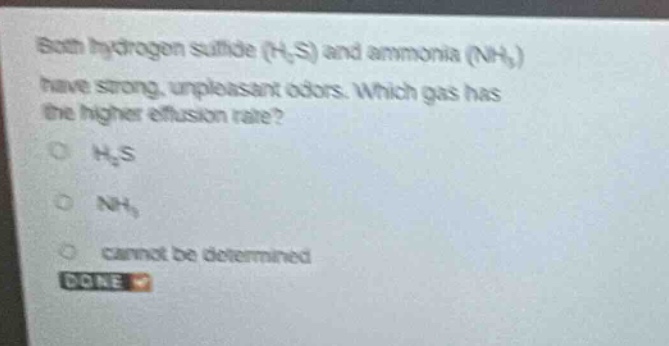
both hydrogen sulfide (h₂s) and ammonia (nh₃) have strong, unpleasant odors. which gas has the higher effusion rate?\no h₂s\no nh₃\no cannot be determined\ndone
Answer
Explanation:
Step1: Recall Graham's law of effusion
According to Graham's law of effusion, the rate of effusion of a gas is inversely proportional to the square - root of its molar mass ($r\propto\frac{1}{\sqrt{M}}$), where $r$ is the rate of effusion and $M$ is the molar mass of the gas. The gas with the lower molar mass will have a higher effusion rate.
Step2: Calculate the molar mass of $H_2S$
The molar mass of $H_2S$: The molar mass of $H$ is approximately $1\ g/mol$ and the molar mass of $S$ is approximately $32\ g/mol$. So, $M_{H_2S}=2\times1 + 32=34\ g/mol$.
Step3: Calculate the molar mass of $NH_3$
The molar mass of $NH_3$: The molar mass of $N$ is approximately $14\ g/mol$ and the molar mass of $H$ is approximately $1\ g/mol$. So, $M_{NH_3}=14 + 3\times1=17\ g/mol$.
Step4: Compare the molar masses
Since $M_{NH_3}(17\ g/mol)<M_{H_2S}(34\ g/mol)$, according to Graham's law of effusion, $NH_3$ has a higher effusion rate.
Answer:
$NH_3$