to identify or compare substances, scientists often study the substances characteristic properties. a…
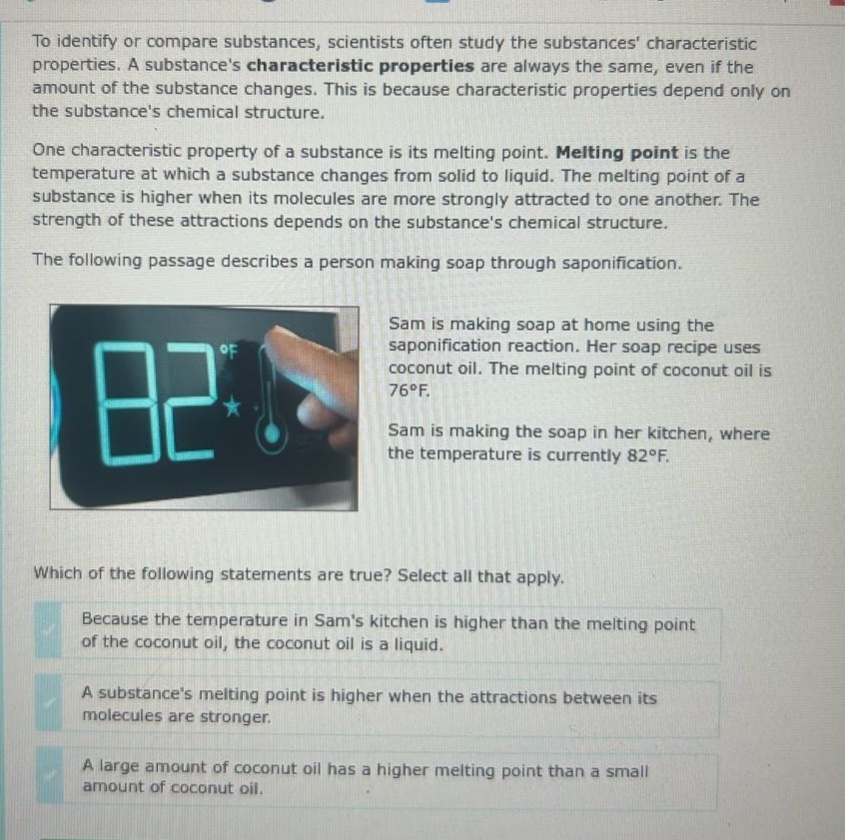
to identify or compare substances, scientists often study the substances characteristic properties. a substances characteristic properties are always the same, even if the amount of the substance changes. this is because characteristic properties depend only on the substances chemical structure. one characteristic property of a substance is its melting point. melting point is the temperature at which a substance changes from solid to liquid. the melting point of a substance is higher when its molecules are more strongly attracted to one another. the strength of these attractions depends on the substances chemical structure. the following passage describes a person making soap through saponification. sam is making soap at home using the saponification reaction. her soap recipe uses coconut oil. the melting point of coconut oil is 76°f. sam is making the soap in her kitchen, where the temperature is currently 82°f. which of the following statements are true? select all that apply. because the temperature in sams kitchen is higher than the melting point of the coconut oil, the coconut oil is a liquid. a substances melting point is higher when the attractions between its molecules are stronger. a large amount of coconut oil has a higher melting point than a small amount of coconut oil.
Answer
Brief Explanations:
- Since the kitchen temperature ($82^{\circ}F$) is higher than the melting - point of coconut oil ($76^{\circ}F$), coconut oil is in liquid state as it has melted.
- The text clearly states that a substance's melting point is higher when the attractions between its molecules are stronger.
- A substance's characteristic properties like melting point depend only on its chemical structure, not on the amount of the substance. So, a large and a small amount of coconut oil have the same melting point. The third statement is false.
Answer:
Because the temperature in Sam's kitchen is higher than the melting point of the coconut oil, the coconut oil is a liquid. A substance's melting point is higher when the attractions between its molecules are stronger.