identify the following as physical (p) or chemical (c) changes.\n1. nacl (table salt) dissolves in…
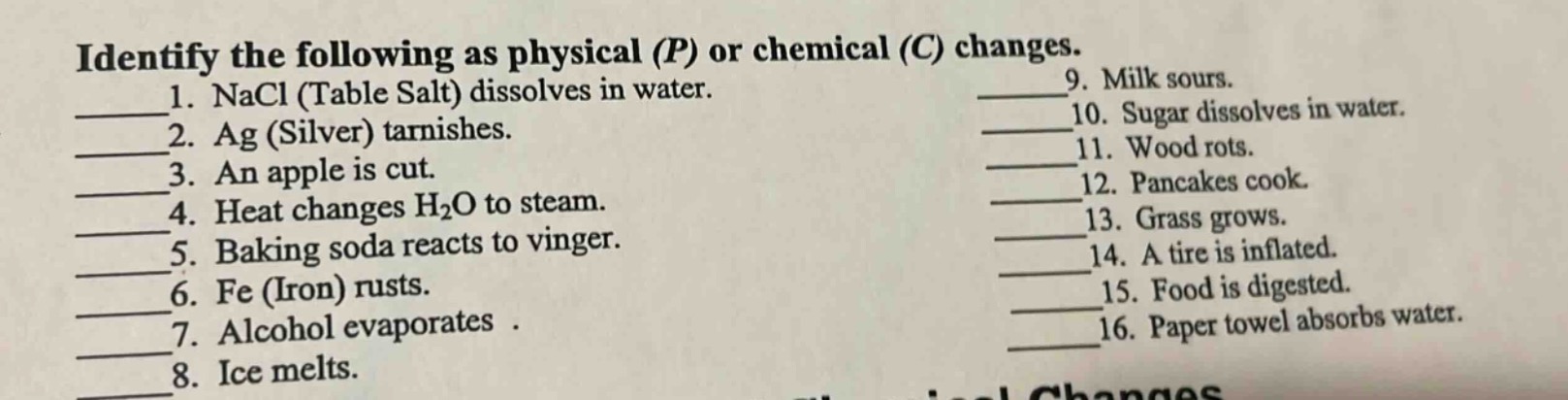
identify the following as physical (p) or chemical (c) changes.\n1. nacl (table salt) dissolves in water.\n2. ag (silver) tarnishes.\n3. an apple is cut.\n4. heat changes h₂o to steam.\n5. baking soda reacts to vinger.\n6. fe (iron) rusts.\n7. alcohol evaporates.\n8. ice melts.\n9. milk sours.\n10. sugar dissolves in water.\n11. wood rots.\n12. pancakes cook.\n13. grass grows.\n14. a tire is inflated.\n15. food is digested.\n16. paper towel absorbs water.
Answer
Explanation:
Step1: Recall physical - chemical change criteria
Physical changes don't change substance identity; chemical changes form new substances.
Step2: Analyze each case
- NaCl dissolving in water is a physical change as no new substance is formed. Just a mixture of ions in water. So it's P.
- Silver tarnishing is a chemical change as silver reacts with sulfur - containing compounds in air to form silver sulfide. So it's C.
- Cutting an apple is a physical change as it only changes the physical form, not the chemical composition. So it's P.
- Heating water to steam is a physical change as it's a phase change of water from liquid to gas without changing the chemical identity of water. So it's P.
- Baking soda reacting with vinegar is a chemical change as carbon dioxide, water and other products are formed. So it's C.
- Iron rusting is a chemical change as iron reacts with oxygen and water to form iron oxide. So it's C.
- Alcohol evaporating is a physical change as it's a phase change from liquid to gas without changing the chemical nature of alcohol. So it's P.
- Ice melting is a physical change as it's a phase change from solid to liquid of water without changing the chemical identity of water. So it's P.
- Milk souring is a chemical change as bacteria convert lactose in milk into lactic acid. So it's C.
- Sugar dissolving in water is a physical change as no new substance is formed, just a sugar - water solution. So it's P.
- Wood rotting is a chemical change as microorganisms break down the complex organic compounds in wood. So it's C.
- Pancakes cooking is a chemical change as heat causes chemical reactions in the batter like the Maillard reaction. So it's C.
- Grass growing is a chemical change as plants use photosynthesis and other biochemical processes to grow and form new substances. So it's C.
- Inflating a tire is a physical change as it just changes the volume of air in the tire, no new substances are formed. So it's P.
- Food digestion is a chemical change as enzymes break down complex food molecules into simpler ones. So it's C.
- Paper towel absorbing water is a physical change as it's just a process of capillary action without changing the chemical nature of either the paper or water. So it's P.
Answer:
- P
- C
- P
- P
- C
- C
- P
- P
- C
- P
- C
- C
- C
- P
- C
- P