identifying factors affecting the rate of a chemical reaction\ndetermine which factors will increase the…
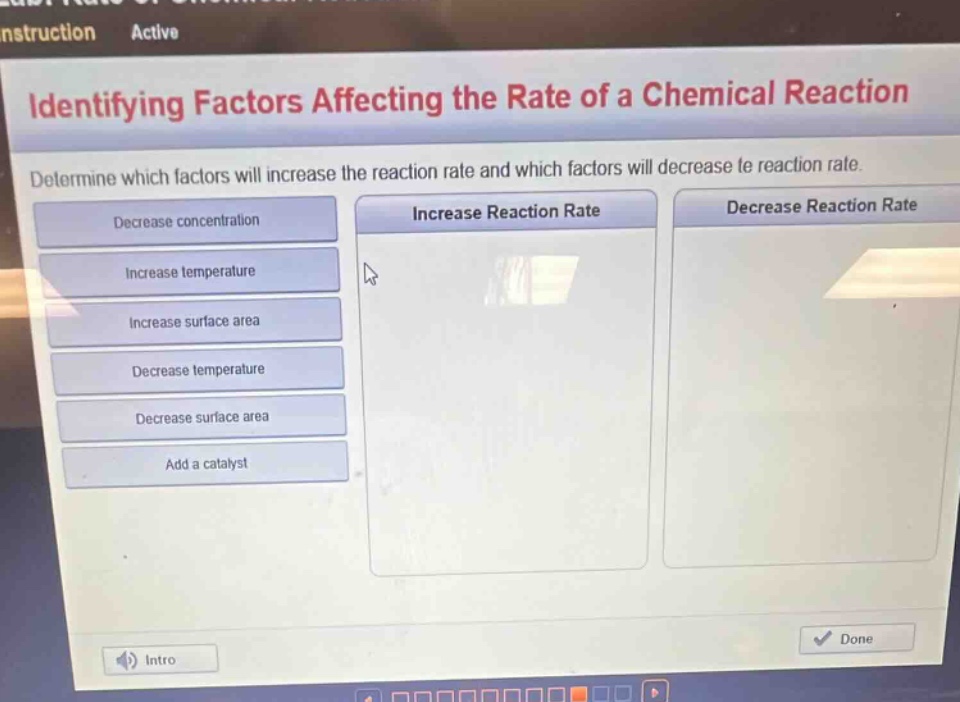
identifying factors affecting the rate of a chemical reaction\ndetermine which factors will increase the reaction rate and which factors will decrease the reaction rate.\ndecrease concentration\nincrease temperature\nincrease surface area\ndecrease temperature\ndecrease surface area\nadd a catalyst\nincrease reaction rate\ndecrease reaction rate
Answer
Explanation:
Step1: Recall reaction - rate factors
Increasing temperature provides more kinetic energy to reactant particles, increasing collision frequency and reaction rate.
Step2: Consider surface - area effect
Increasing surface area exposes more reactant particles, allowing for more collisions and increasing reaction rate.
Step3: Understand catalyst function
A catalyst lowers the activation energy, making it easier for the reaction to occur and increasing the reaction rate.
Step4: Analyze concentration impact
Decreasing concentration means fewer reactant particles, resulting in fewer collisions and a decreased reaction rate.
Step5: Analyze temperature decrease
Decreasing temperature reduces kinetic energy, leading to fewer effective collisions and a decreased reaction rate.
Step6: Analyze surface - area decrease
Decreasing surface area reduces the number of exposed reactant particles, decreasing collision frequency and reaction rate.
Answer:
Increase Reaction Rate: Increase temperature, Increase surface area, Add a catalyst Decrease Reaction Rate: Decrease concentration, Decrease temperature, Decrease surface area