identifying types of reactions\nidentify the chemical reactions as endothermic, exothermic, or neither.\nan…
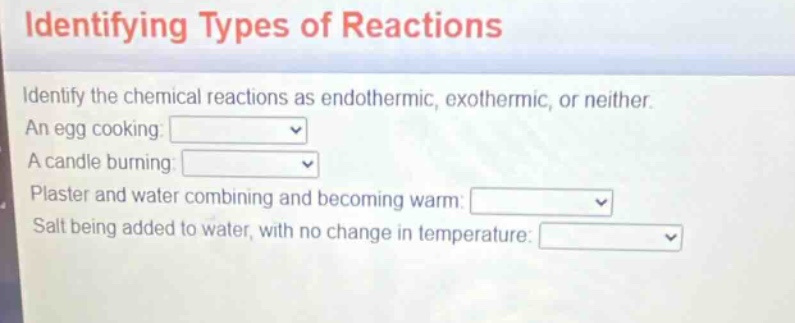
identifying types of reactions\nidentify the chemical reactions as endothermic, exothermic, or neither.\nan egg cooking:\na candle burning:\nplaster and water combining and becoming warm:\nsalt being added to water, with no change in temperature:
Answer
Explanation:
Step1: Analyze egg - cooking
Cooking an egg requires heat input from an external source to change the chemical structure of proteins in the egg. So it is an endothermic reaction.
Step2: Analyze candle - burning
When a candle burns, it releases heat and light energy to the surroundings. So it is an exothermic reaction.
Step3: Analyze plaster - water combination
When plaster and water combine and become warm, heat is released to the surroundings. So it is an exothermic reaction.
Step4: Analyze salt - water addition
Since there is no change in temperature when salt is added to water, there is no significant heat absorption or release. So it is neither endothermic nor exothermic.
Answer:
An egg cooking: Endothermic A candle burning: Exothermic Plaster and water combining and becoming warm: Exothermic Salt being added to water, with no change in temperature: Neither