the image below is a representation of a carbon atom and sulfur atom that are bonded together. which answer…
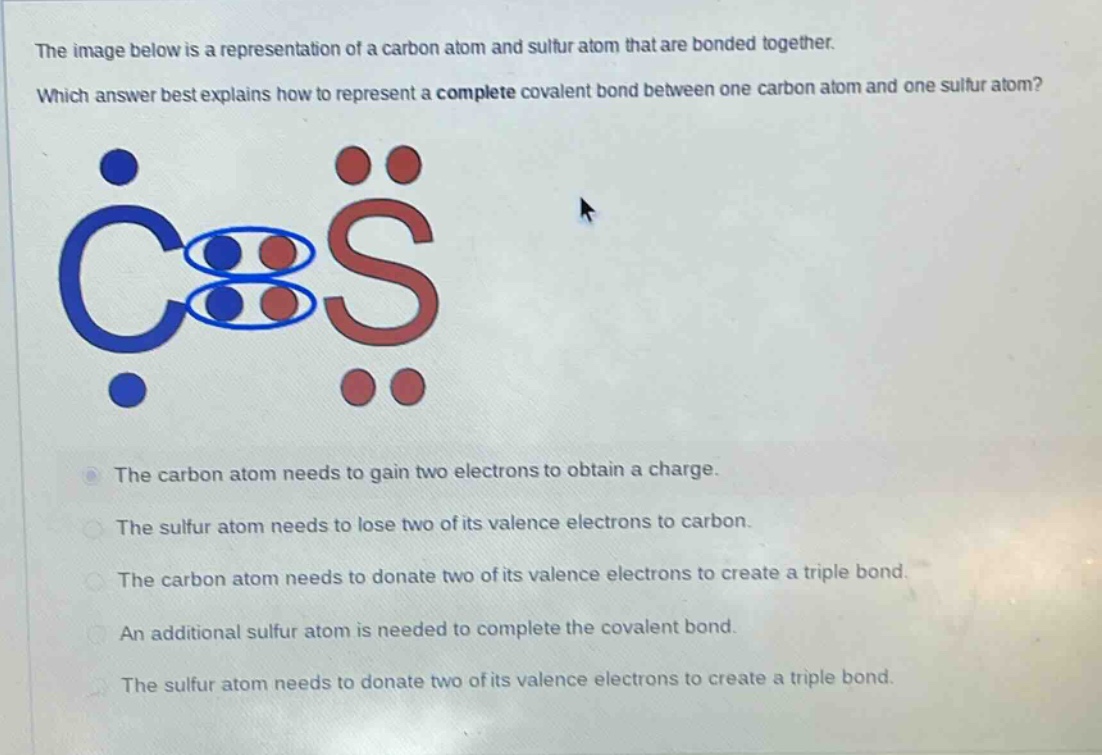
the image below is a representation of a carbon atom and sulfur atom that are bonded together. which answer best explains how to represent a complete covalent bond between one carbon atom and one sulfur atom? the carbon atom needs to gain two electrons to obtain a charge. the sulfur atom needs to lose two of its valence electrons to carbon. the carbon atom needs to donate two of its valence electrons to create a triple bond. an additional sulfur atom is needed to complete the covalent bond. the sulfur atom needs to donate two of its valence electrons to create a triple bond.
Answer
Brief Explanations:
A covalent bond is formed by sharing electrons. Carbon has 4 valence - electrons and sulfur has 6 valence - electrons. To complete their octets, they share electrons. In a double - bond (as shown in the image), electrons are shared between the atoms. The carbon atom has 4 valence electrons and needs 4 more to complete its octet, and sulfur has 6 valence electrons and needs 2 more. They share electrons to achieve stable electron configurations. The carbon atom does not need to gain two electrons to obtain a charge as it forms covalent bonds by sharing electrons. Sulfur does not need to lose electrons to carbon, nor does carbon or sulfur need to donate electrons to form a triple - bond in this case. And an additional sulfur atom is not needed.
Answer:
None of the provided options are correct as the image shows a double - covalent bond where electrons are shared between carbon and sulfur to complete their octets.