the incomplete table below shows selected characteristics of different types of bonds.\n| row | bond | cause…
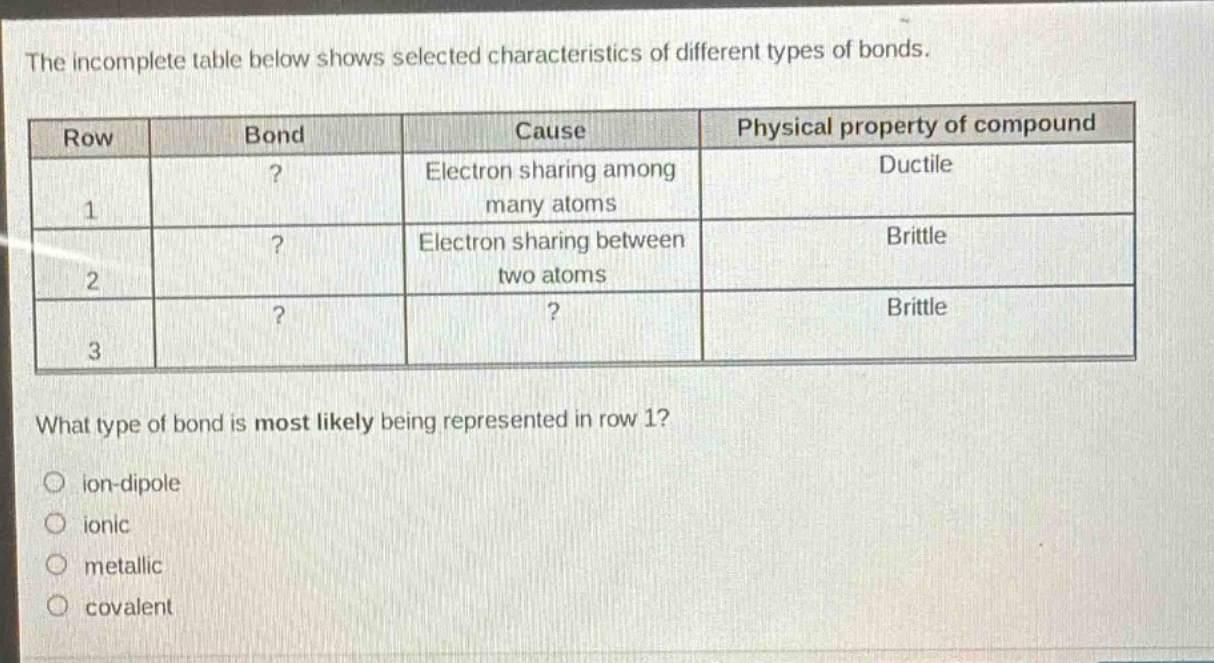
the incomplete table below shows selected characteristics of different types of bonds.\n| row | bond | cause | physical property of compound |\n| ---- | ---- | ---- | ---- |\n| 1 | ? | electron sharing among many atoms | ductile |\n| 2 | ? | electron sharing between two atoms | brittle |\n| 3 | ? | ? | brittle |\nwhat type of bond is most likely being represented in row 1?\n○ ion - dipole\n○ ionic\n○ metallic\n○ covalent
Answer
Brief Explanations:
Metallic bonds involve electron sharing among many atoms (sea - of - electrons model) and metals are typically ductile. Ion - dipole bonds involve an ion and a dipole, ionic bonds are due to electron transfer, and covalent bonds are electron sharing between two atoms.
Answer:
C. metallic