the incomplete table below shows selected properties of compounds that have ionic, covalent, or metallic…
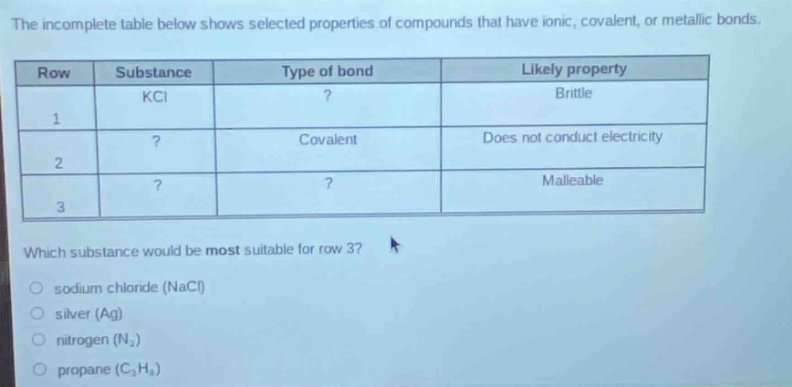
the incomplete table below shows selected properties of compounds that have ionic, covalent, or metallic bonds.\n| row | substance | type of bond | likely property |\n| ---- | ---- | ---- | ---- |\n| 1 | kcl |? | brittle |\n| 2 |? | covalent | does not conduct electricity |\n| 3 |? |? | malleable |\nwhich substance would be most suitable for row 3?\n- sodium chloride (nacl)\n- silver (ag)\n- nitrogen (n₂)\n- propane (c₃h₈)
Answer
Answer:
B. silver (Ag)
Explanation:
Step1: Recall bond - property relationships
Metallic bonds result in malleability. Ionic compounds like sodium chloride are brittle. Covalent compounds like nitrogen ($N_2$) and propane ($C_3H_8$) do not have metallic properties.
Step2: Identify the metal
Silver (Ag) has metallic bonds and is malleable. Sodium chloride (NaCl) has ionic bonds. Nitrogen ($N_2$) and propane ($C_3H_8$) have covalent bonds.