indicate whether each change will result in an increase or decrease in the rate of reaction. increase in…
indicate whether each change will result in an increase or decrease in the rate of reaction. increase in rate of reaction decrease in rate of reaction no change the activation energy gets higher. concentration of reactants increase an inert gas is added to the system activation energy drops frequency of collisions goes up temperature of the system increases the molecular rate of collisions decreases. a catalyst is added to the system orientation of molecules is not favorable.
Answer
Explanation:
Step1: Understand activation - energy effect
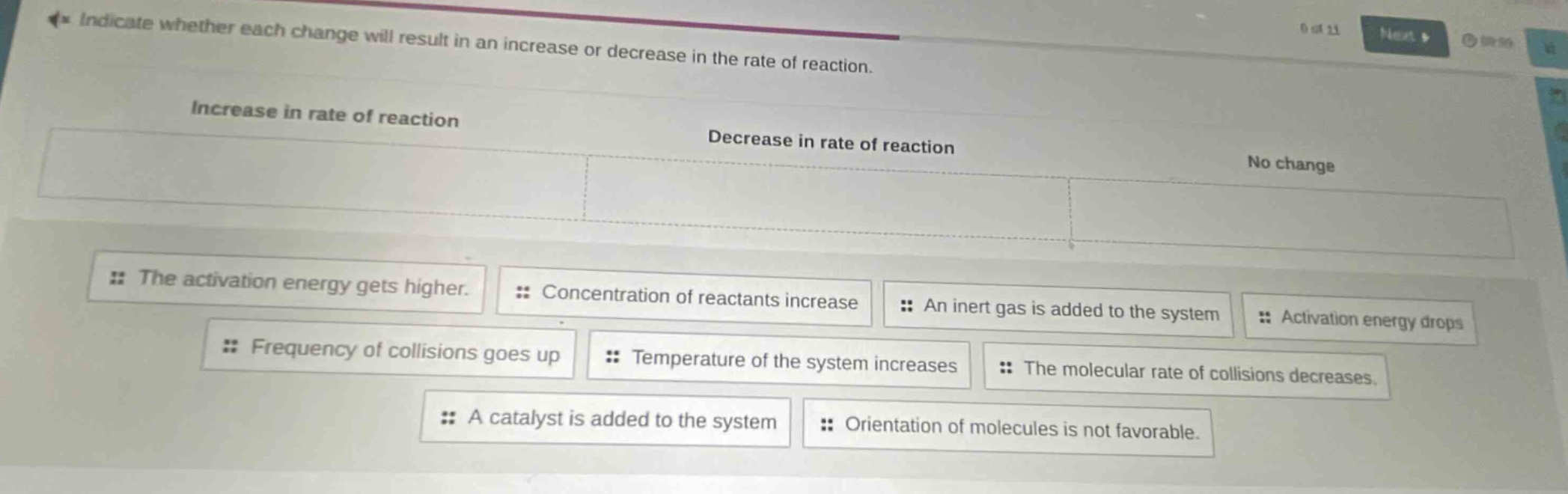
Higher activation energy makes it harder for reactants to react, decreasing the rate. So, "The activation energy gets higher" leads to a decrease in rate of reaction.
Step2: Analyze reactant - concentration effect
Increasing the concentration of reactants increases the number of available particles for collision, increasing the reaction rate. So, "Concentration of reactants increase" leads to an increase in rate of reaction.
Step3: Consider inert - gas addition
Adding an inert gas does not change the concentration of reactants or the collision frequency between reactant molecules. So, "An inert gas is added to the system" results in no change in the rate of reaction.
Step4: Evaluate activation - energy drop
A drop in activation energy makes it easier for reactants to react, increasing the rate. So, "Activation energy drops" leads to an increase in rate of reaction.
Step5: Analyze collision - frequency increase
An increase in the frequency of collisions means more opportunities for reactant molecules to react, increasing the rate. So, "Frequency of collisions goes up" leads to an increase in rate of reaction.
Step6: Consider temperature - increase effect
Increasing the temperature increases the kinetic energy of molecules, leading to more frequent and energetic collisions, increasing the rate. So, "Temperature of the system increases" leads to an increase in rate of reaction.
Step7: Evaluate collision - rate decrease
A decrease in the molecular rate of collisions means fewer opportunities for reactant molecules to react, decreasing the rate. So, "The molecular rate of collisions decreases" leads to a decrease in rate of reaction.
Step8: Analyze catalyst - addition effect
A catalyst lowers the activation energy, increasing the reaction rate. So, "A catalyst is added to the system" leads to an increase in rate of reaction.
Step9: Consider molecular - orientation effect
An unfavorable orientation of molecules reduces the probability of effective collisions, decreasing the rate. So, "Orientation of molecules is not favorable" leads to a decrease in rate of reaction.
Answer:
Increase in rate of reaction: Concentration of reactants increase, Activation energy drops, Frequency of collisions goes up, Temperature of the system increases, A catalyst is added to the system Decrease in rate of reaction: The activation energy gets higher, The molecular rate of collisions decreases, Orientation of molecules is not favorable No change: An inert gas is added to the system