the information below describes a redox reaction.\nag⁺(aq) + al(s) → ag(s) + al³⁺(aq)\nag⁺(aq) + e⁻ →…
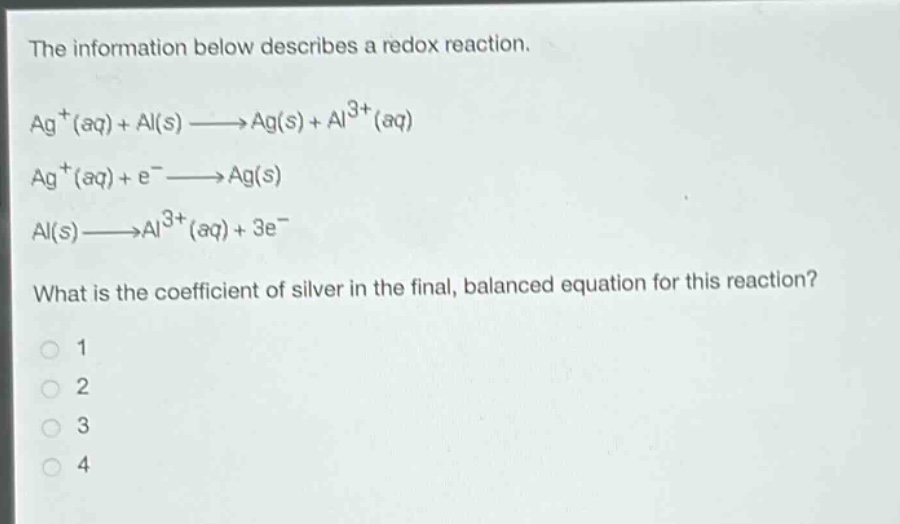
the information below describes a redox reaction.\nag⁺(aq) + al(s) → ag(s) + al³⁺(aq)\nag⁺(aq) + e⁻ → ag(s)\nal(s) → al³⁺(aq) + 3e⁻\nwhat is the coefficient of silver in the final, balanced equation for this reaction?\n1\n2\n3\n4
Answer
Explanation:
Step1: Balance the electrons
The half - reaction for silver has 1 electron gain ($Ag^+(aq)+e^-\rightarrow Ag(s)$) and the half - reaction for aluminum has 3 electron loss ($Al(s)\rightarrow Al^{3 + }(aq)+3e^-$). To balance the electrons, we multiply the silver half - reaction by 3. $3Ag^+(aq)+3e^-\rightarrow 3Ag(s)$ $Al(s)\rightarrow Al^{3 + }(aq)+3e^-$
Step2: Combine the half - reactions
Adding the two balanced half - reactions: $3Ag^+(aq)+Al(s)\rightarrow 3Ag(s)+Al^{3 + }(aq)$
Answer:
3