the information below describes a redox reaction.\ncr^{3 + }(aq)+2cl^{-}(aq)→cr(s)+cl_{2}(g)\n2cl^{-}(aq)→cl_…
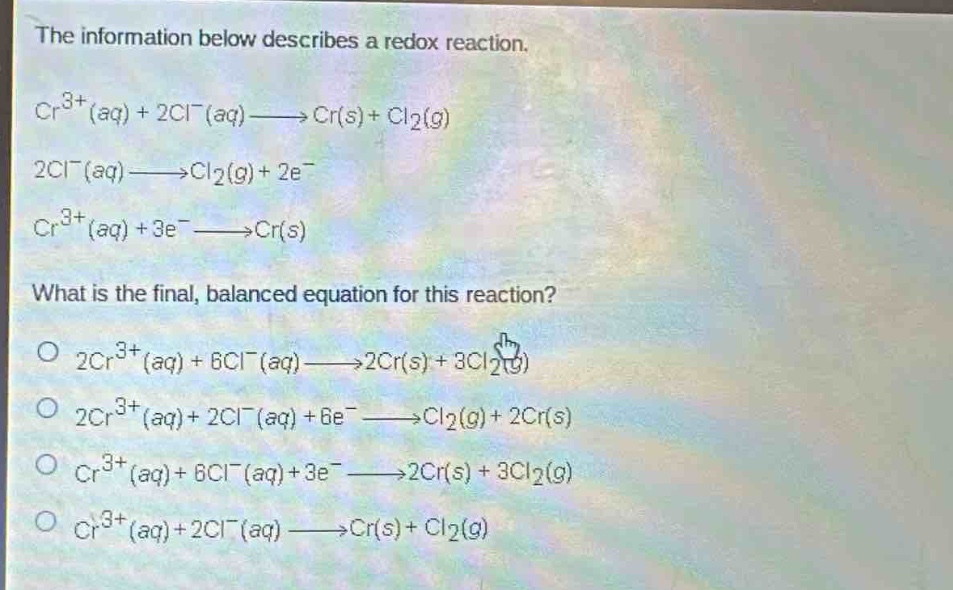
the information below describes a redox reaction.\ncr^{3 + }(aq)+2cl^{-}(aq)→cr(s)+cl_{2}(g)\n2cl^{-}(aq)→cl_{2}(g)+2e^{-}\ncr^{3 + }(aq)+3e^{-}→cr(s)\nwhat is the final, balanced equation for this reaction?\n2cr^{3 + }(aq)+6cl^{-}(aq)→2cr(s)+3cl_{2}(g)\n2cr^{3 + }(aq)+2cl^{-}(aq)+6e^{-}→cl_{2}(g)+2cr(s)\ncr^{3 + }(aq)+6cl^{-}(aq)+3e^{-}→2cr(s)+3cl_{2}(g)\ncr^{3 + }(aq)+2cl^{-}(aq)→cr(s)+cl_{2}(g)
Answer
Explanation:
Step1: Determine electron - transfer balance
The oxidation half - reaction is $2Cl^-(aq)\longrightarrow Cl_2(g)+2e^-$ and the reduction half - reaction is $Cr^{3 +}(aq)+3e^-\longrightarrow Cr(s)$. To balance the electrons, we need to find the least common multiple of 2 and 3, which is 6.
Step2: Multiply half - reactions
Multiply the oxidation half - reaction by 3: $6Cl^-(aq)\longrightarrow 3Cl_2(g)+6e^-$ and the reduction half - reaction by 2: $2Cr^{3 +}(aq)+6e^-\longrightarrow 2Cr(s)$.
Step3: Combine half - reactions
Add the two multiplied half - reactions together: $2Cr^{3 +}(aq)+6Cl^-(aq)\longrightarrow 2Cr(s)+3Cl_2(g)$.
Answer:
$2Cr^{3 +}(aq)+6Cl^-(aq)\longrightarrow 2Cr(s)+3Cl_2(g)$