interpreting a chemical reaction what quantitative information is revealed by this chemical equation…
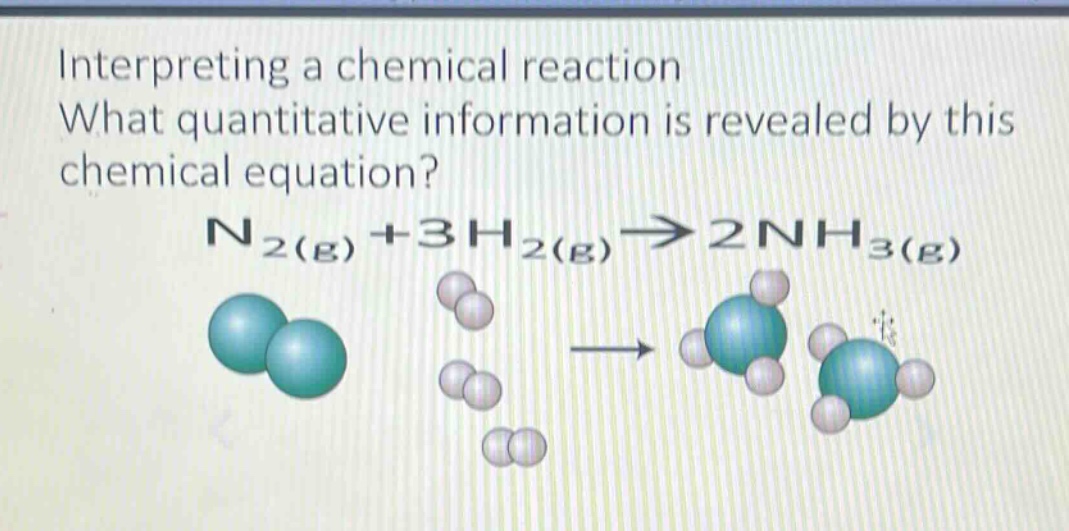
interpreting a chemical reaction what quantitative information is revealed by this chemical equation? n2(g)+3h2(g)→2nh3(g)
Answer
Explanation:
Step1: Identify mole - ratios
The coefficients in the balanced chemical equation $N_2(g)+3H_2(g)\rightarrow2NH_3(g)$ give the mole - ratios. For every 1 mole of $N_2$, 3 moles of $H_2$ react to produce 2 moles of $NH_3$.
Step2: Interpret mass - relationships
Using molar masses, we can calculate mass relationships. The molar mass of $N_2$ is approximately 28 g/mol, $H_2$ is approximately 2 g/mol, and $NH_3$ is approximately 17 g/mol. So, 28 g of $N_2$ reacts with 6 g of $H_2$ to produce 34 g of $NH_3$.
Step3: Consider volume relationships (at same T and P)
According to Avogadro's law, at the same temperature and pressure, the volume ratios are the same as the mole - ratios. So, 1 volume of $N_2$ reacts with 3 volumes of $H_2$ to produce 2 volumes of $NH_3$.
Answer:
The chemical equation reveals mole - ratios (1 mole $N_2$ : 3 moles $H_2$ : 2 moles $NH_3$), mass - relationships (28 g $N_2$ reacts with 6 g $H_2$ to form 34 g $NH_3$), and volume - relationships (1 volume $N_2$ : 3 volumes $H_2$ : 2 volumes $NH_3$ at same T and P).