intro to the mole - practice problems\n1. how many atoms of potassium make up one mole?\n2. how many atoms…
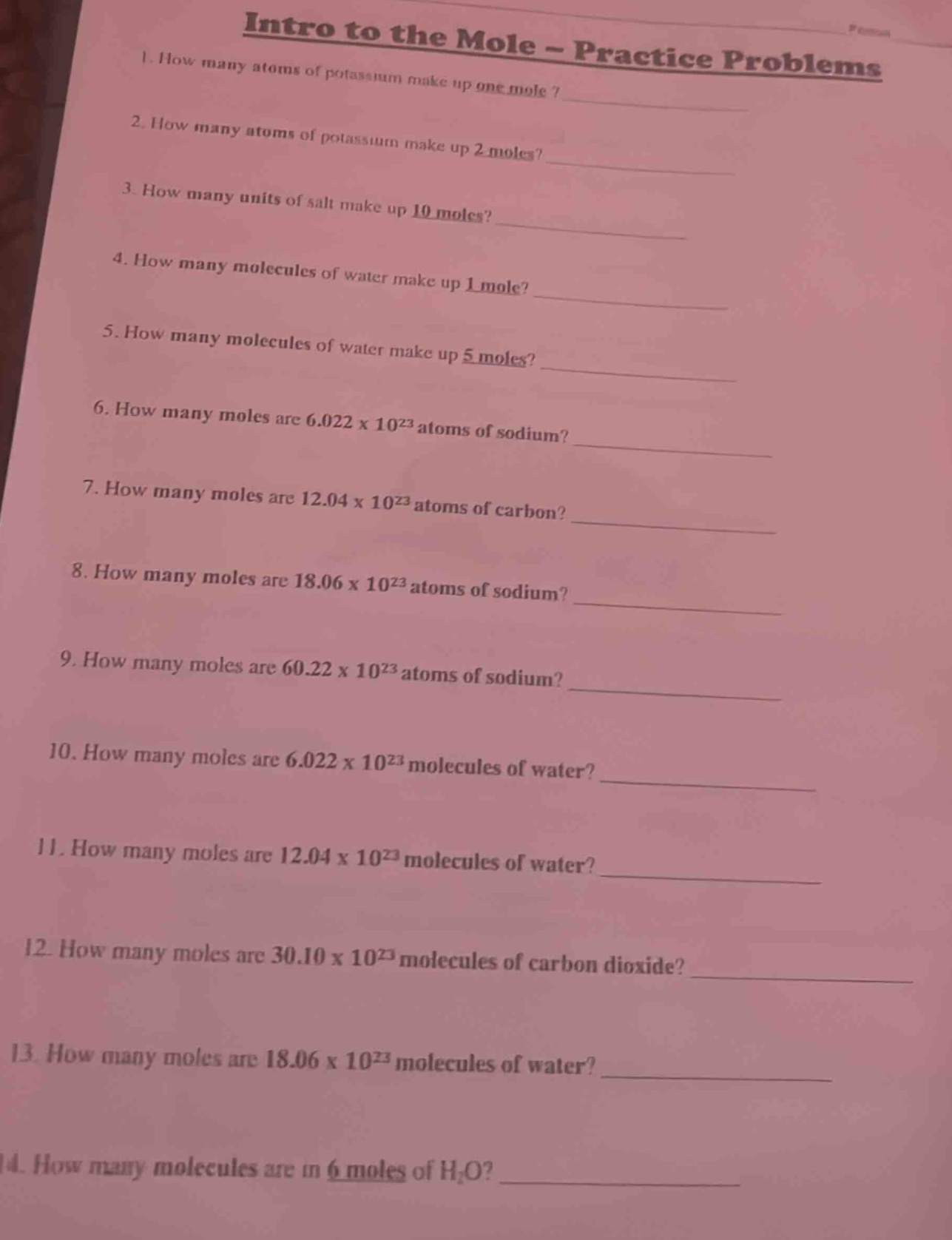
intro to the mole - practice problems\n1. how many atoms of potassium make up one mole?\n2. how many atoms of potassium make up 2 moles?\n3. how many units of salt make up 10 moles?\n4. how many molecules of water make up 1 mole?\n5. how many molecules of water make up 5 moles?\n6. how many moles are 6.022 x 10²³ atoms of sodium?\n7. how many moles are 12.04 x 10²³ atoms of carbon?\n8. how many moles are 18.06 x 10²³ atoms of sodium?\n9. how many moles are 60.22 x 10²³ atoms of sodium?\n10. how many moles are 6.022 x 10²³ molecules of water?\n11. how many moles are 12.04 x 10²³ molecules of water?\n12. how many moles are 30.10 x 10²³ molecules of carbon dioxide?\n13. how many moles are 18.06 x 10²³ molecules of water?\n14. how many molecules are in 6 moles of h₂o?
Answer
Explanation:
Step1: Recall Avogadro's number
Avogadro's number ($N_A$) is $6.022\times 10^{23}$ entities per mole.
Step2: Solve problem 1
One - mole of any substance contains $6.022\times 10^{23}$ atoms. So, for potassium, the number of atoms in one mole is $6.022\times 10^{23}$ atoms.
Step3: Solve problem 2
Since 1 mole of potassium has $6.022\times 10^{23}$ atoms, 2 moles of potassium have $n = 2\times6.022\times 10^{23}=1.2044\times 10^{24}$ atoms.
Step4: Solve problem 3
1 mole of any substance contains $6.022\times 10^{23}$ units. So, 10 moles of salt have $n = 10\times6.022\times 10^{23}=6.022\times 10^{24}$ units.
Step5: Solve problem 4
1 mole of water contains $6.022\times 10^{23}$ molecules.
Step6: Solve problem 5
If 1 mole of water has $6.022\times 10^{23}$ molecules, 5 moles of water have $n = 5\times6.022\times 10^{23}=3.011\times 10^{24}$ molecules.
Step7: Solve problem 6
We use the formula $n=\frac{N}{N_A}$, where $N$ is the number of atoms and $N_A = 6.022\times 10^{23}$. Given $N = 6.022\times 10^{23}$ atoms of sodium, $n=\frac{6.022\times 10^{23}}{6.022\times 10^{23}} = 1$ mole.
Step8: Solve problem 7
Given $N = 12.04\times 10^{23}$ atoms of carbon, $n=\frac{12.04\times 10^{23}}{6.022\times 10^{23}}=2$ moles.
Step9: Solve problem 8
Given $N = 18.06\times 10^{23}$ atoms of sodium, $n=\frac{18.06\times 10^{23}}{6.022\times 10^{23}} = 3$ moles.
Step10: Solve problem 9
Given $N = 60.22\times 10^{23}$ atoms of sodium, $n=\frac{60.22\times 10^{23}}{6.022\times 10^{23}}=10$ moles.
Step11: Solve problem 10
Since $N_A = 6.022\times 10^{23}$ molecules per mole, for $N = 6.022\times 10^{23}$ molecules of water, $n = 1$ mole.
Step12: Solve problem 11
Given $N = 12.04\times 10^{23}$ molecules of water, $n=\frac{12.04\times 10^{23}}{6.022\times 10^{23}} = 2$ moles.
Step13: Solve problem 12
Given $N = 30.10\times 10^{23}$ molecules of carbon - dioxide, $n=\frac{30.10\times 10^{23}}{6.022\times 10^{23}}=5$ moles.
Step14: Solve problem 13
Given $N = 18.06\times 10^{23}$ molecules of water, $n=\frac{18.06\times 10^{23}}{6.022\times 10^{23}}=3$ moles.
Step15: Solve problem 14
If 1 mole of $H_2O$ has $6.022\times 10^{23}$ molecules, 6 moles of $H_2O$ have $n = 6\times6.022\times 10^{23}=3.6132\times 10^{24}$ molecules.
Answer:
- $6.022\times 10^{23}$ atoms
- $1.2044\times 10^{24}$ atoms
- $6.022\times 10^{24}$ units
- $6.022\times 10^{23}$ molecules
- $3.011\times 10^{24}$ molecules
- 1 mole
- 2 moles
- 3 moles
- 10 moles
- 1 mole
- 2 moles
- 5 moles
- 3 moles
- $3.6132\times 10^{24}$ molecules