introduction: the electrons that orbit the nucleus of an atom are arranged into shells. the first shell…
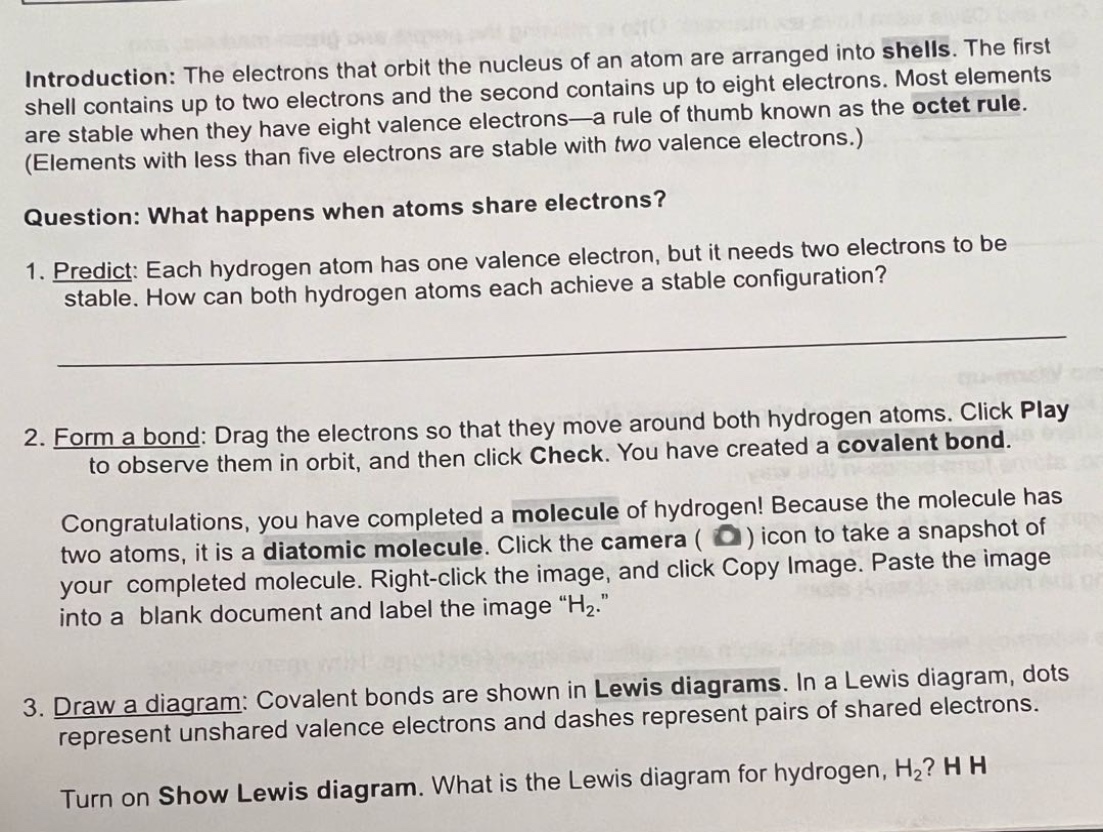
introduction: the electrons that orbit the nucleus of an atom are arranged into shells. the first shell contains up to two electrons and the second contains up to eight electrons. most elements are stable when they have eight valence electrons—a rule of thumb known as the octet rule. (elements with less than five electrons are stable with two valence electrons.) question: what happens when atoms share electrons? 1. predict: each hydrogen atom has one valence electron, but it needs two electrons to be stable. how can both hydrogen atoms each achieve a stable configuration? 2. form a bond: drag the electrons so that they move around both hydrogen atoms. click play to observe them in orbit, and then click check. you have created a covalent bond. congratulations, you have completed a molecule of hydrogen! because the molecule has two atoms, it is a diatomic molecule. click the camera ( ) icon to take a snapshot of your completed molecule. right - click the image, and click copy image. paste the image into a blank document and label the image “h₂.” 3. draw a diagram: covalent bonds are shown in lewis diagrams. in a lewis diagram, dots represent unshared valence electrons and dashes represent pairs of shared electrons. turn on show lewis diagram. what is the lewis diagram for hydrogen, h₂? h h
Answer
Explanation:
Step1: Analizar la estabilidad de átomos de hidrógeno
Cada átomo de hidrógeno tiene 1 electrón de valencia y necesita 2 para ser estable. Al compartir electrones, pueden alcanzar la estabilidad.
Step2: Comprender el enlace covalente
Dos átomos de hidrógeno comparten un par de electrones, formando un enlace covalente y un átomo diatómico de hidrógeno ($H_2$).
Step3: Dibujar el diagrama de Lewis
En el diagrama de Lewis para $H_2$, se representan los átomos de hidrógeno y un guión entre ellos que representa el par de electrones compartidos. El diagrama es $H - H$.
Answer:
El diagrama de Lewis para $H_2$ es $H - H$