ions formation worksheet\ncomplete the following table.\nelement ionic symbol cation anion\nli\no\nn\nna\ns\n…
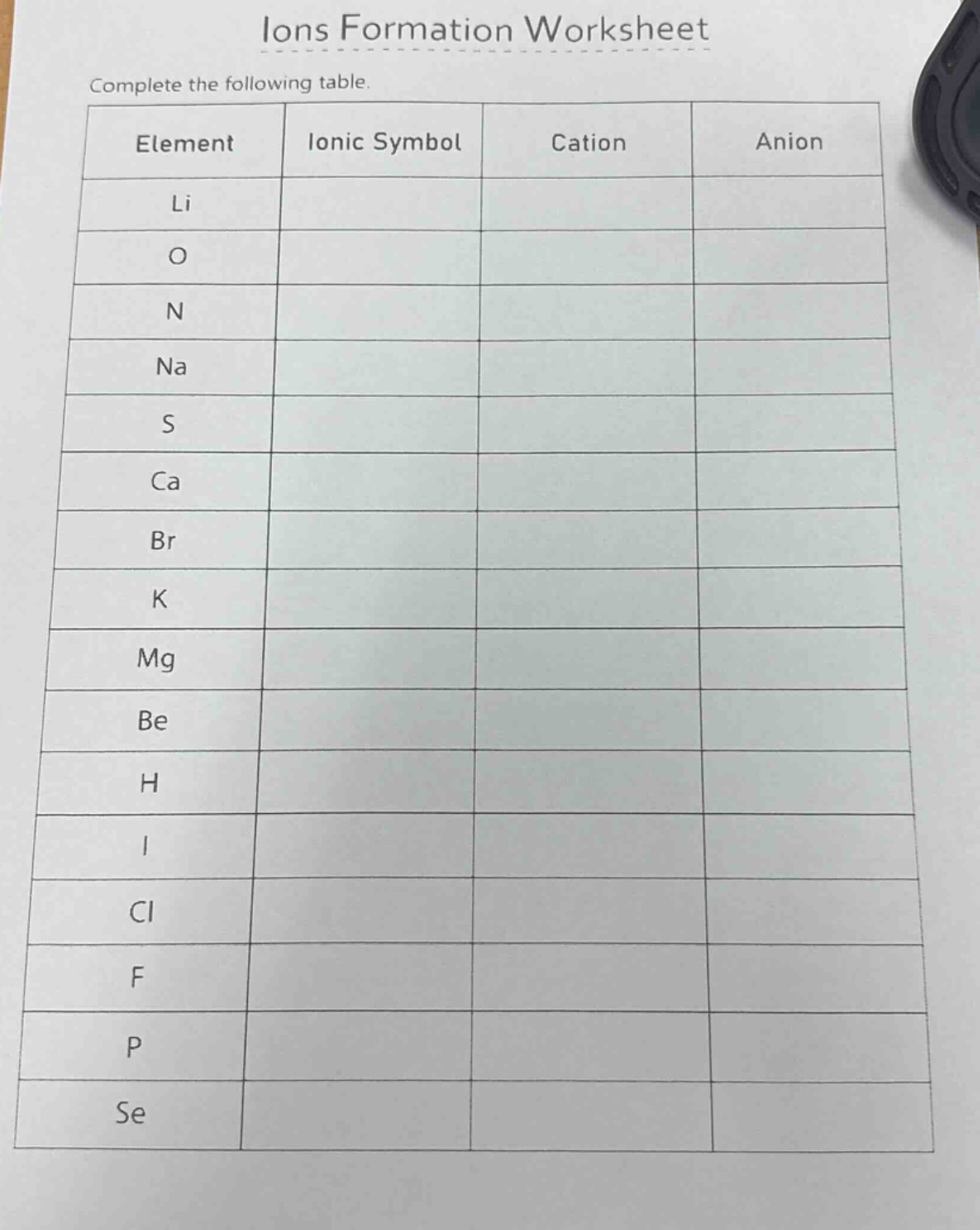
ions formation worksheet\ncomplete the following table.\nelement ionic symbol cation anion\nli\no\nn\nna\ns\nca\nbr\nk\nmg\nbe\nh\ni\ncl\nf\np\nse
Answer
Explanation:
Step1: Determine ion - formation rules
Metals tend to lose electrons to form cations and non - metals tend to gain electrons to form anions. The number of electrons lost or gained is based on achieving a stable electron configuration (usually a noble - gas configuration).
Step2: Analyze Li
Lithium (Li) is a metal in Group 1. It has 1 valence electron and loses 1 electron to form a cation. The ionic symbol is $Li^+$, cation is $Li^+$, and there is no common simple anion for Li.
Step3: Analyze O
Oxygen (O) is a non - metal in Group 16. It has 6 valence electrons and gains 2 electrons to form an anion. The ionic symbol is $O^{2 - }$, anion is $O^{2 - }$, and there is no common simple cation for O.
Step4: Analyze N
Nitrogen (N) is a non - metal in Group 15. It has 5 valence electrons and gains 3 electrons to form an anion. The ionic symbol is $N^{3 - }$, anion is $N^{3 - }$, and there is no common simple cation for N.
Step5: Analyze Na
Sodium (Na) is a metal in Group 1. It has 1 valence electron and loses 1 electron to form a cation. The ionic symbol is $Na^+$, cation is $Na^+$, and there is no common simple anion for Na.
Step6: Analyze S
Sulfur (S) is a non - metal in Group 16. It has 6 valence electrons and gains 2 electrons to form an anion. The ionic symbol is $S^{2 - }$, anion is $S^{2 - }$, and there is no common simple cation for S.
Step7: Analyze Ca
Calcium (Ca) is a metal in Group 2. It has 2 valence electrons and loses 2 electrons to form a cation. The ionic symbol is $Ca^{2+}$, cation is $Ca^{2+}$, and there is no common simple anion for Ca.
Step8: Analyze Br
Bromine (Br) is a non - metal in Group 17. It has 7 valence electrons and gains 1 electron to form an anion. The ionic symbol is $Br^-$, anion is $Br^-$, and there is no common simple cation for Br.
Step9: Analyze K
Potassium (K) is a metal in Group 1. It has 1 valence electron and loses 1 electron to form a cation. The ionic symbol is $K^+$, cation is $K^+$, and there is no common simple anion for K.
Step10: Analyze Mg
Magnesium (Mg) is a metal in Group 2. It has 2 valence electrons and loses 2 electrons to form a cation. The ionic symbol is $Mg^{2+}$, cation is $Mg^{2+}$, and there is no common simple anion for Mg.
Step11: Analyze Be
Beryllium (Be) is a metal in Group 2. It has 2 valence electrons and loses 2 electrons to form a cation. The ionic symbol is $Be^{2+}$, cation is $Be^{2+}$, and there is no common simple anion for Be.
Step12: Analyze H
Hydrogen (H) can act as a metal and lose 1 electron to form $H^+$ (cation) or act as a non - metal and gain 1 electron to form $H^-$ (anion). The ionic symbols are $H^+$ and $H^-$, cation is $H^+$, anion is $H^-$.
Step13: Analyze I
Iodine (I) is a non - metal in Group 17. It has 7 valence electrons and gains 1 electron to form an anion. The ionic symbol is $I^-$, anion is $I^-$, and there is no common simple cation for I.
Step14: Analyze Cl
Chlorine (Cl) is a non - metal in Group 17. It has 7 valence electrons and gains 1 electron to form an anion. The ionic symbol is $Cl^-$, anion is $Cl^-$, and there is no common simple cation for Cl.
Step15: Analyze F
Fluorine (F) is a non - metal in Group 17. It has 7 valence electrons and gains 1 electron to form an anion. The ionic symbol is $F^-$, anion is $F^-$, and there is no common simple cation for F.
Step16: Analyze P
Phosphorus (P) is a non - metal in Group 15. It has 5 valence electrons and gains 3 electrons to form an anion. The ionic symbol is $P^{3 - }$, anion is $P^{3 - }$, and there is no common simple cation for P.
Step17: Analyze Se
Selenium (Se) is a non - metal in Group 16. It has 6 valence electrons and gains 2 electrons to form an anion. The ionic symbol is $Se^{2 - }$, anion is $Se^{2 - }$, and there is no common simple cation for Se.
Answer:
| Element | Ionic Symbol | Cation | Anion |
|---|---|---|---|
| Li | $Li^+$ | $Li^+$ | |
| O | $O^{2 - }$ | $O^{2 - }$ | |
| N | $N^{3 - }$ | $N^{3 - }$ | |
| Na | $Na^+$ | $Na^+$ | |
| S | $S^{2 - }$ | $S^{2 - }$ | |
| Ca | $Ca^{2+}$ | $Ca^{2+}$ | |
| Br | $Br^-$ | $Br^-$ | |
| K | $K^+$ | $K^+$ | |
| Mg | $Mg^{2+}$ | $Mg^{2+}$ | |
| Be | $Be^{2+}$ | $Be^{2+}$ | |
| H | $H^+$, $H^-$ | $H^+$ | $H^-$ |
| I | $I^-$ | $I^-$ | |
| Cl | $Cl^-$ | $Cl^-$ | |
| F | $F^-$ | $F^-$ | |
| P | $P^{3 - }$ | $P^{3 - }$ | |
| Se | $Se^{2 - }$ | $Se^{2 - }$ |