why do the isotopes of a particular element behave differently in nuclear reactions but the same in chemical…
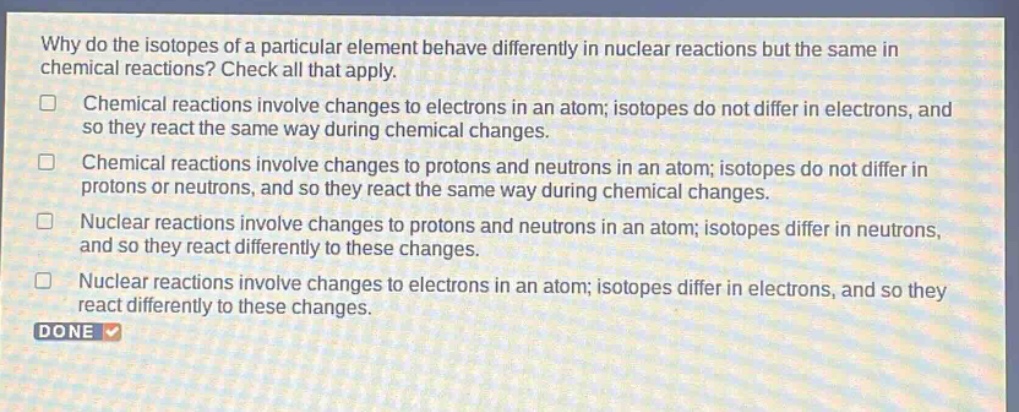
why do the isotopes of a particular element behave differently in nuclear reactions but the same in chemical reactions? check all that apply. chemical reactions involve changes to electrons in an atom; isotopes do not differ in electrons, and so they react the same way during chemical changes. chemical reactions involve changes to protons and neutrons in an atom; isotopes do not differ in protons or neutrons, and so they react the same way during chemical changes. nuclear reactions involve changes to protons and neutrons in an atom; isotopes differ in neutrons, and so they react differently to these changes. nuclear reactions involve changes to electrons in an atom; isotopes differ in electrons, and so they react differently to these changes. done
Answer
Brief Explanations:
Chemical reactions involve electrons and isotopes have the same electron - configuration, so they react the same chemically. Nuclear reactions involve changes in the nucleus where isotopes differ in neutrons, causing different nuclear behavior.
Answer:
- Chemical reactions involve changes to electrons in an atom; isotopes do not differ in electrons, and so they react the same way during chemical changes.
- Nuclear reactions involve changes to protons and neutrons in an atom; isotopes differ in neutrons, and so they react differently to these changes.