all large radioactive atoms decay into smaller atoms by releasing alpha particles. each alpha particle has 2…
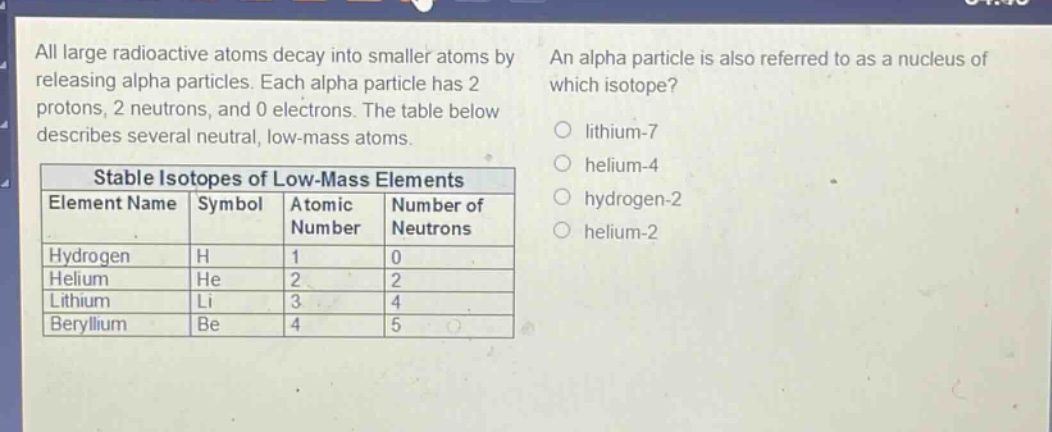
all large radioactive atoms decay into smaller atoms by releasing alpha particles. each alpha particle has 2 protons, 2 neutrons, and 0 electrons. the table below describes several neutral, low - mass atoms. stable isotopes of low - mass elements element name symbol atomic number number of neutrons hydrogen h 1 0 helium he 2 2 lithium li 3 4 beryllium be 4 5 an alpha particle is also referred to as a nucleus of which isotope? lithium - 7 helium - 4 hydrogen - 2 helium - 2
Answer
Explanation:
Step1: Recall alpha - particle composition
An alpha particle has 2 protons and 2 neutrons.
Step2: Match with isotope
The atomic number of an element is equal to the number of protons. Helium has an atomic number of 2. The mass number is the sum of protons and neutrons, so for an alpha - particle with 2 protons and 2 neutrons, the mass number is 4. So an alpha - particle is a helium - 4 nucleus.
Answer:
helium-4