lead is malleable, so it can be pounded into flat sheets without breaking. how does the bonding within lead…
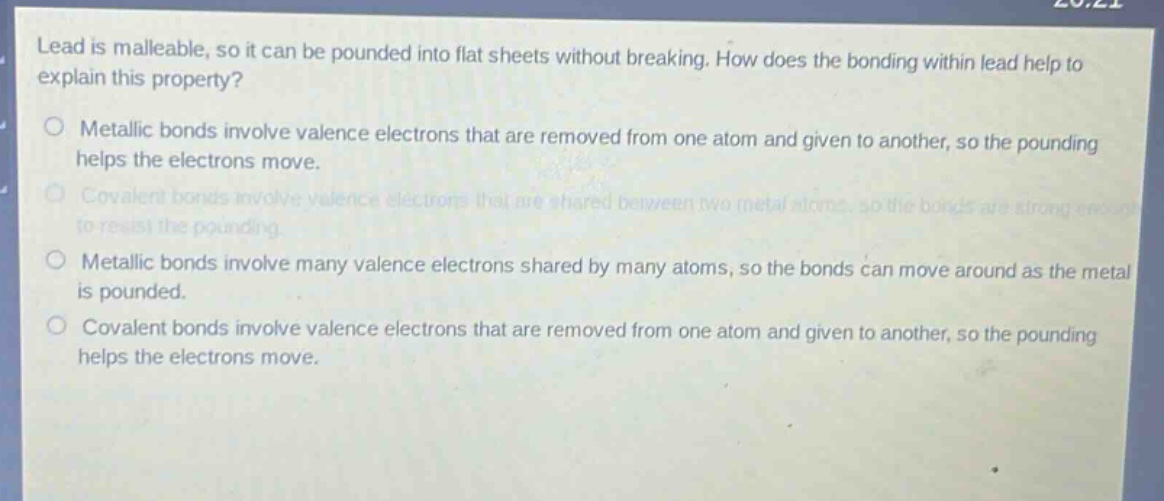
lead is malleable, so it can be pounded into flat sheets without breaking. how does the bonding within lead help to explain this property?\nmetallic bonds involve valence electrons that are removed from one atom and given to another, so the pounding helps the electrons move.\ncovalent bonds involve valence electrons that are shared between two metal atoms, so the bonds are strong enough to resist the pounding.\nmetallic bonds involve many valence electrons shared by many atoms, so the bonds can move around as the metal is pounded.\ncovalent bonds involve valence electrons that are removed from one atom and given to another, so the pounding helps the electrons move.
Answer
Brief Explanations:
Lead is a metal. Metallic bonding involves a sea of delocalized valence - electrons shared by many atoms. When the metal is pounded, these mobile electrons allow the atoms to slide past each other without breaking the bond, which explains malleability. Covalent bonds involve sharing between specific atoms and are not relevant here, and the description of electron transfer in the first and fourth options is incorrect for metallic bonding.
Answer:
Metallic bonds involve many valence electrons shared by many atoms, so the bonds can move around as the metal is pounded.