looking at the heating curves for water (h₂o) and ethyl alcohol (c₂h₅oh), formulate an explanation for the…
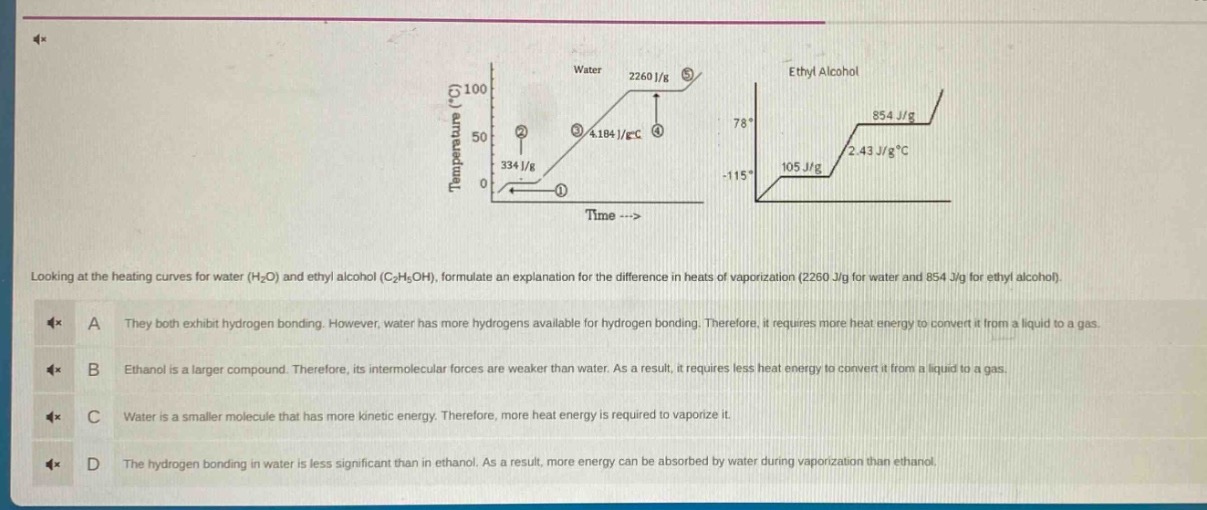
looking at the heating curves for water (h₂o) and ethyl alcohol (c₂h₅oh), formulate an explanation for the difference in heats of vaporization (2260 j/g for water and 854 j/g for ethyl alcohol).\na they both exhibit hydrogen bonding. however, water has more hydrogens available for hydrogen bonding. therefore, it requires more heat energy to convert it from a liquid to a gas.\nb ethanol is a larger compound. therefore, its intermolecular forces are weaker than water. as a result, it requires less heat energy to convert it from a liquid to a gas.\nc water is a smaller molecule that has more kinetic energy. therefore, more heat energy is required to vaporize it.\nd the hydrogen bonding in water is less significant than in ethanol. as a result, more energy can be absorbed by water during vaporization than ethanol.
Answer
Brief Explanations:
- Option A: Water ((H_2O)) and ethyl alcohol ((C_2H_5OH)) both have hydrogen - bonding. Water has two (O - H) bonds per molecule, while ethyl alcohol has one (O - H) bond per molecule. More hydrogen - bonding in water means stronger intermolecular forces. Stronger intermolecular forces require more energy to break, so more heat energy is needed to convert water from liquid to gas (higher heat of vaporization).
- Option B: Ethyl alcohol ((C_2H_5OH)) has a larger molar mass than water ((H_2O)), but the key factor is hydrogen - bonding. Water has more extensive hydrogen - bonding (not weaker intermolecular forces due to size in a way that would explain the heat of vaporization difference as stated).
- Option C: Kinetic energy is related to temperature. At the boiling point (where vaporization occurs), the average kinetic energy of molecules in the liquid is the same for both substances (at their respective boiling points). The size of the molecule in terms of kinetic energy at the boiling point is not the reason for the heat of vaporization difference.
- Option D: Water has more significant hydrogen - bonding than ethyl alcohol (because of more (O - H) bonds available for hydrogen - bonding per molecule), not less.
Answer:
A. They both exhibit hydrogen bonding. However, water has more hydrogens available for hydrogen bonding. Therefore, it requires more heat energy to convert it from a liquid to a gas.