loren has the samples of elements that are listed below at room temperature. he exposes the samples to the…
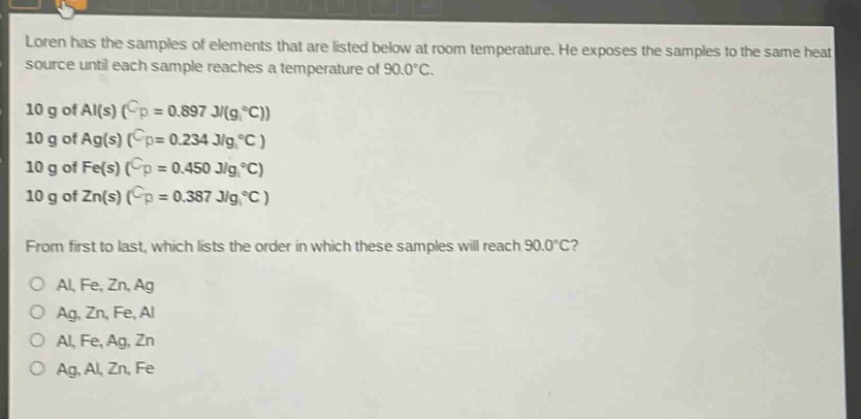
loren has the samples of elements that are listed below at room temperature. he exposes the samples to the same heat source until each sample reaches a temperature of 90.0°c. 10 g of al(s) (cp = 0.897 j/(g°c)) 10 g of ag(s) (cp = 0.234 j/(g°c)) 10 g of fe(s) (cp = 0.450 j/(g°c)) 10 g of zn(s) (cp = 0.387 j/(g°c)) from first to last, which lists the order in which these samples will reach 90.0°c? al, fe, zn, ag ag, zn, fe, al al, fe, ag, zn ag, al, zn, fe
Answer
Explanation:
Step1: Recall heat - capacity concept
The lower the specific heat capacity ($C_p$), the less heat is required to raise the temperature of a given mass of the substance. Since the mass of each sample is the same (10 g) and they are exposed to the same heat source, substances with lower $C_p$ values will reach the target temperature ($90.0^{\circ}C$) faster.
Step2: Compare specific - heat capacities
We have $C_{p,Al}=0.897\ J/(g^{\circ}C)$, $C_{p,Ag}=0.234\ J/(g^{\circ}C)$, $C_{p,Fe}=0.450\ J/(g^{\circ}C)$ and $C_{p,Zn}=0.387\ J/(g^{\circ}C)$. Arranging the specific - heat capacities in ascending order: $C_{p,Ag}<C_{p,Zn}<C_{p,Fe}<C_{p,Al}$.
Step3: Determine order of reaching temperature
The order in which the samples will reach $90.0^{\circ}C$ from first to last is the order of increasing specific - heat capacities. So the order is Ag, Zn, Fe, Al.
Answer:
Ag, Zn, Fe, Al