the main acid in the stomach is hydrochloric acid (hcl). which chemical equations show a reaction that…
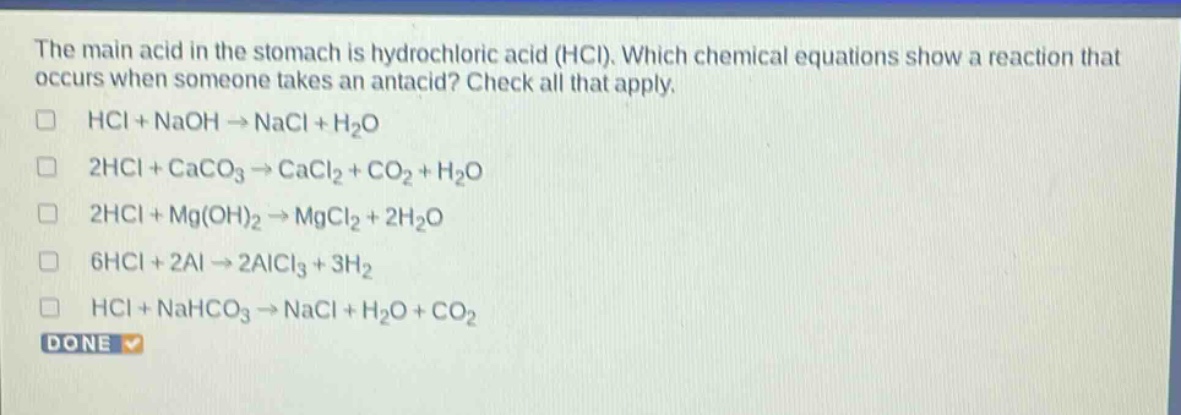
the main acid in the stomach is hydrochloric acid (hcl). which chemical equations show a reaction that occurs when someone takes an antacid? check all that apply. hcl + naoh → nacl + h2o 2hcl + caco3 → cacl2 + co2 + h2o 2hcl + mg(oh)2 → mgcl2 + 2h2o 6hcl + 2al → 2alcl3 + 3h2 hcl + nahco3 → nacl + h2o + co2 done
Answer
Answer:
B. $2HCl + CaCO_{3}\rightarrow CaCl_{2}+CO_{2}+H_{2}O$, C. $2HCl + Mg(OH){2}\rightarrow MgCl{2}+2H_{2}O$, E. $HCl + NaHCO_{3}\rightarrow NaCl + H_{2}O+CO_{2}$
Explanation:
Step1: Understand antacid - acid reaction
Antacids are bases or basic salts that react with stomach - acid ($HCl$) to neutralize it.
Step2: Analyze each equation
- $HCl + NaOH\rightarrow NaCl + H_{2}O$: $NaOH$ is a strong base not typically used as an antacid as it is too caustic.
- $2HCl + CaCO_{3}\rightarrow CaCl_{2}+CO_{2}+H_{2}O$: $CaCO_{3}$ (calcium carbonate) is a common antacid ingredient. It reacts with $HCl$ to neutralize acid.
- $2HCl + Mg(OH){2}\rightarrow MgCl{2}+2H_{2}O$: $Mg(OH)_{2}$ (magnesium hydroxide) is a common antacid. It neutralizes $HCl$.
- $6HCl + 2Al\rightarrow 2AlCl_{3}+3H_{2}$: This is a metal - acid reaction, not an antacid - acid reaction.
- $HCl + NaHCO_{3}\rightarrow NaCl + H_{2}O+CO_{2}$: $NaHCO_{3}$ (sodium bicarbonate) is a common antacid. It reacts with $HCl$ to neutralize it.