how many cis/trans isomers does this molecule have? enter the number in the box above the drawing area…
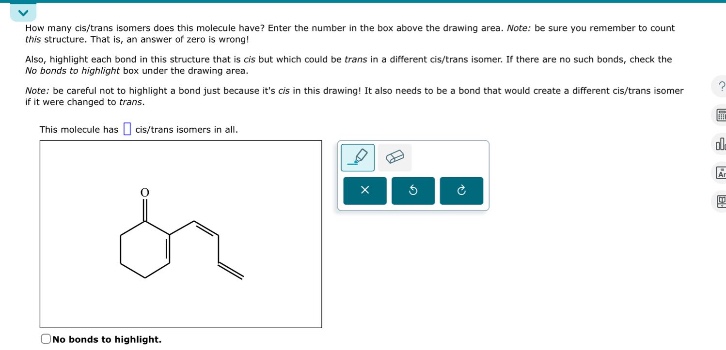
how many cis/trans isomers does this molecule have? enter the number in the box above the drawing area. note: be sure you remember to count this structure. that is, an answer of zero is wrong! also, highlight each bond in this structure that is cis but which could be trans in a different cis/trans isomer. if there are no such bonds, check the no bonds to highlight box under the drawing area. note: be careful not to highlight a bond just because its cis in this drawing! it also needs to be a bond that would create a different cis/trans isomer if it were changed to trans. this molecule has cis/trans isomers in all. no bonds to highlight.
Answer
Explanation:
Step1: Identify double - bond positions
The molecule has two double - bonds. One is in the six - membered ring and the other is in the side - chain.
Step2: Analyze cis/trans isomerism for each double - bond
For the double - bond in the six - membered ring, it can have cis/trans isomerism. For the double - bond in the side - chain, it can also have cis/trans isomerism.
Step3: Calculate the number of cis/trans isomers
Each double - bond can give rise to 2 isomers (cis and trans). Using the formula (2^n) where (n) is the number of double - bonds with cis/trans isomerism, here (n = 2), so (2^2=4).
Answer:
4