1. what mass of precipitate is formed when 2.93 g of potassium iodide in solution reacts with excess lead…
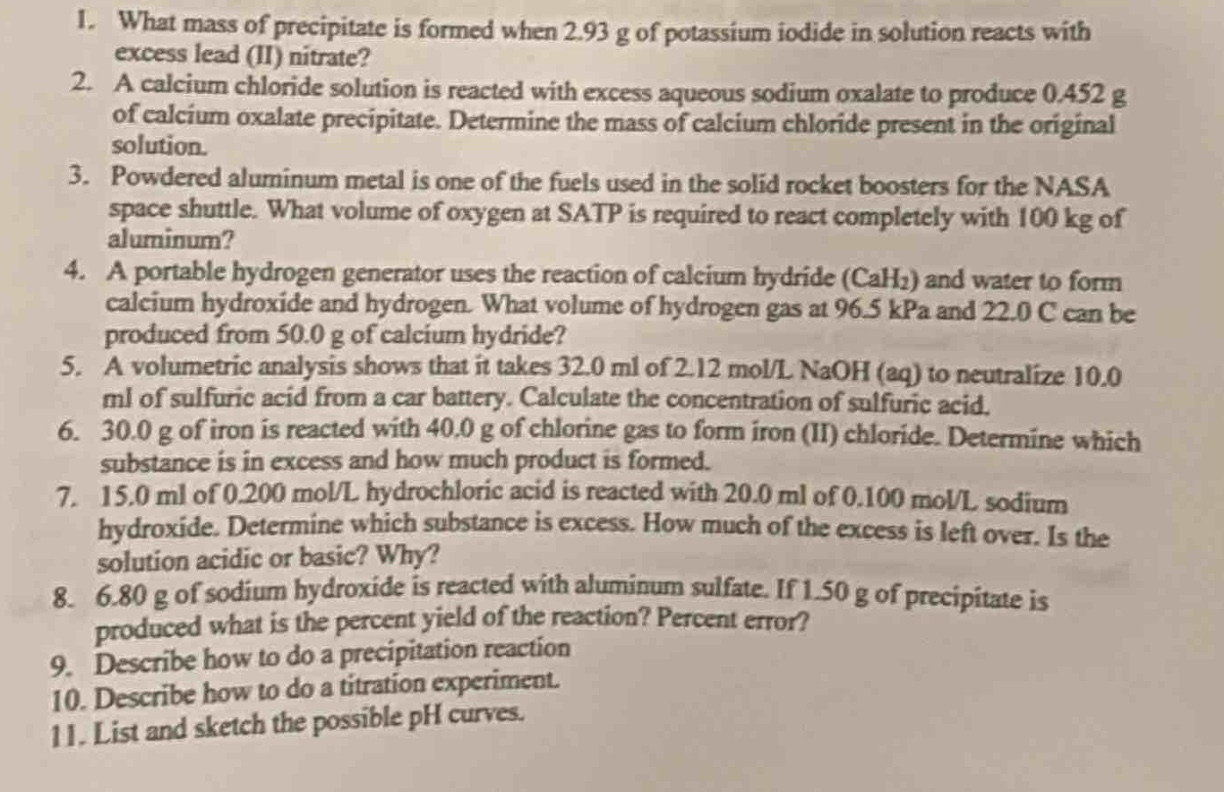
1. what mass of precipitate is formed when 2.93 g of potassium iodide in solution reacts with excess lead (ii) nitrate?\n2. a calcium chloride solution is reacted with excess aqueous sodium oxalate to produce 0.452 g of calcium oxalate precipitate. determine the mass of calcium chloride present in the original solution.\n3. powdered aluminum metal is one of the fuels used in the solid rocket boosters for the nasa space shuttle. what volume of oxygen at satp is required to react completely with 100 kg of aluminum?\n4. a portable hydrogen generator uses the reaction of calcium hydride (cah₂) and water to form calcium hydroxide and hydrogen. what volume of hydrogen gas at 96.5 kpa and 22.0 c can be produced from 50.0 g of calcium hydride?\n5. a volumetric analysis shows that it takes 32.0 ml of 2.12 mol/l naoh (aq) to neutralize 10.0 ml of sulfuric acid from a car battery. calculate the concentration of sulfuric acid.\n6. 30.0 g of iron is reacted with 40.0 g of chlorine gas to form iron (ii) chloride. determine which substance is in excess and how much product is formed.\n7. 15.0 ml of 0.200 mol/l hydrochloric acid is reacted with 20.0 ml of 0.100 mol/l sodium hydroxide. determine which substance is excess. how much of the excess is left over. is the solution acidic or basic? why?\n8. 6.80 g of sodium hydroxide is reacted with aluminum sulfate. if 1.50 g of precipitate is produced what is the percent yield of the reaction? percent error?\n9. describe how to do a precipitation reaction\n10. describe how to do a titration experiment\n11. list and sketch the possible ph curves.
Answer
Explanation:
Step1: Write the chemical equation
$2KI(aq)+Pb(NO_3)_2(aq)=PbI_2(s)+2KNO_3(aq)$
Step2: Calculate the molar - mass of $KI$
The molar - mass of $KI$, $M_{KI}=39 + 127=166g/mol$. The number of moles of $KI$, $n_{KI}=\frac{m_{KI}}{M_{KI}}=\frac{2.93g}{166g/mol}=0.01765mol$.
Step3: Determine the mole ratio
From the balanced equation, the mole ratio of $KI$ to $PbI_2$ is $2:1$. So the number of moles of $PbI_2$, $n_{PbI_2}=\frac{1}{2}n_{KI}=\frac{1}{2}\times0.01765mol = 0.008825mol$.
Step4: Calculate the molar - mass of $PbI_2$
The molar - mass of $PbI_2$, $M_{PbI_2}=207+2\times127 = 461g/mol$. The mass of $PbI_2$, $m_{PbI_2}=n_{PbI_2}\times M_{PbI_2}=0.008825mol\times461g/mol = 4.07g$.
Answer:
$4.07g$
Explanation:
Step1: Write the chemical equation
$CaCl_2(aq)+Na_2C_2O_4(aq)=CaC_2O_4(s)+2NaCl(aq)$
Step2: Calculate the molar - mass of $CaC_2O_4$
The molar - mass of $CaC_2O_4$, $M_{CaC_2O_4}=40 + 2\times12+4\times16=128g/mol$. The number of moles of $CaC_2O_4$, $n_{CaC_2O_4}=\frac{m_{CaC_2O_4}}{M_{CaC_2O_4}}=\frac{0.452g}{128g/mol}=0.00353mol$.
Step3: Determine the mole ratio
From the balanced equation, the mole ratio of $CaCl_2$ to $CaC_2O_4$ is $1:1$. So the number of moles of $CaCl_2$, $n_{CaCl_2}=n_{CaC_2O_4}=0.00353mol$.
Step4: Calculate the molar - mass of $CaCl_2$
The molar - mass of $CaCl_2$, $M_{CaCl_2}=40 + 2\times35.5 = 111g/mol$. The mass of $CaCl_2$, $m_{CaCl_2}=n_{CaCl_2}\times M_{CaCl_2}=0.00353mol\times111g/mol = 0.392g$.
Answer:
$0.392g$
Explanation:
Step1: Write the chemical equation
$4Al(s)+3O_2(g)=2Al_2O_3(s)$
Step2: Calculate the molar - mass of $Al$
The molar - mass of $Al$, $M_{Al}=27g/mol$. The number of moles of $Al$, $n_{Al}=\frac{m_{Al}}{M_{Al}}=\frac{100\times1000g}{27g/mol}=3703.7mol$.
Step3: Determine the mole ratio
From the balanced equation, the mole ratio of $Al$ to $O_2$ is $4:3$. So the number of moles of $O_2$, $n_{O_2}=\frac{3}{4}n_{Al}=\frac{3}{4}\times3703.7mol = 2777.8mol$.
Step4: Use the molar volume at SATP
At SATP ($T = 298K$, $P = 100kPa$), the molar volume $V_m = 24.8L/mol$. The volume of $O_2$, $V_{O_2}=n_{O_2}\times V_m=2777.8mol\times24.8L/mol = 68999.4L\approx69.0\times10^{3}L$.
Answer:
$69.0\times10^{3}L$
Explanation:
Step1: Write the chemical equation
$CaH_2(s)+2H_2O(l)=Ca(OH)_2(s)+2H_2(g)$
Step2: Calculate the molar - mass of $CaH_2$
The molar - mass of $CaH_2$, $M_{CaH_2}=40 + 2\times1=42g/mol$. The number of moles of $CaH_2$, $n_{CaH_2}=\frac{m_{CaH_2}}{M_{CaH_2}}=\frac{50.0g}{42g/mol}=1.19mol$.
Step3: Determine the mole ratio
From the balanced equation, the mole ratio of $CaH_2$ to $H_2$ is $1:2$. So the number of moles of $H_2$, $n_{H_2}=2n_{CaH_2}=2\times1.19mol = 2.38mol$.
Step4: Use the ideal gas law $PV = nRT$
$P = 96.5kPa = 96500Pa$, $T=(22.0 + 273)K=295K$, $R = 8.314J/(mol\cdot K)$ $V=\frac{nRT}{P}=\frac{2.38mol\times8.314J/(mol\cdot K)\times295K}{96500Pa}=0.0605m^{3}=60.5L$
Answer:
$60.5L$
Explanation:
Step1: Write the chemical equation
$2NaOH(aq)+H_2SO_4(aq)=Na_2SO_4(aq)+2H_2O(l)$
Step2: Calculate the number of moles of $NaOH$
$n_{NaOH}=c_{NaOH}\times V_{NaOH}=2.12mol/L\times0.032L = 0.06784mol$.
Step3: Determine the mole ratio
From the balanced equation, the mole ratio of $NaOH$ to $H_2SO_4$ is $2:1$. So the number of moles of $H_2SO_4$, $n_{H_2SO_4}=\frac{1}{2}n_{NaOH}=\frac{1}{2}\times0.06784mol = 0.03392mol$.
Step4: Calculate the concentration of $H_2SO_4$
$c_{H_2SO_4}=\frac{n_{H_2SO_4}}{V_{H_2SO_4}}=\frac{0.03392mol}{0.01L}=3.39mol/L$.
Answer:
$3.39mol/L$
Explanation:
Step1: Write the chemical equation
$Fe(s)+Cl_2(g)=FeCl_2(s)$
Step2: Calculate the molar - mass of $Fe$ and $Cl_2$
The molar - mass of $Fe$, $M_{Fe}=56g/mol$, the molar - mass of $Cl_2$, $M_{Cl_2}=2\times35.5 = 71g/mol$. The number of moles of $Fe$, $n_{Fe}=\frac{m_{Fe}}{M_{Fe}}=\frac{30.0g}{56g/mol}=0.536mol$. The number of moles of $Cl_2$, $n_{Cl_2}=\frac{m_{Cl_2}}{M_{Cl_2}}=\frac{40.0g}{71g/mol}=0.563mol$.
Step3: Determine the limiting and excess reactants
The mole ratio of $Fe$ to $Cl_2$ is $1:1$. Since $n_{Fe}<n_{Cl_2}$, $Fe$ is the limiting reactant and $Cl_2$ is in excess. The number of moles of $FeCl_2$ formed is equal to the number of moles of $Fe$ (because of the 1:1 mole ratio), $n_{FeCl_2}=n_{Fe}=0.536mol$. The mass of $FeCl_2$, $m_{FeCl_2}=n_{FeCl_2}\times M_{FeCl_2}=0.536mol\times(56 + 2\times35.5)g/mol=0.536mol\times127g/mol = 68.1g$. The amount of $Cl_2$ in excess, $\Delta n_{Cl_2}=n_{Cl_2}-n_{Fe}=0.563mol - 0.536mol=0.027mol$.
Answer:
$Cl_2$ is in excess. The mass of $FeCl_2$ formed is $68.1g$.
Explanation:
Step1: Write the chemical equation
$HCl(aq)+NaOH(aq)=NaCl(aq)+H_2O(l)$
Step2: Calculate the number of moles of $HCl$ and $NaOH$
$n_{HCl}=c_{HCl}\times V_{HCl}=0.200mol/L\times0.015L = 0.003mol$. $n_{NaOH}=c_{NaOH}\times V_{NaOH}=0.100mol/L\times0.020L = 0.002mol$.
Step3: Determine the limiting and excess reactants
The mole ratio of $HCl$ to $NaOH$ is $1:1$. Since $n_{HCl}>n_{NaOH}$, $HCl$ is in excess. The amount of $HCl$ in excess, $\Delta n_{HCl}=n_{HCl}-n_{NaOH}=0.003mol - 0.002mol = 0.001mol$. The solution is acidic because there is excess $HCl$ remaining in the solution.
Answer:
$HCl$ is in excess. The amount of excess $HCl$ is $0.001mol$. The solution is acidic because of the excess $HCl$.
Explanation:
Step1: Write the chemical equation
$6NaOH(aq)+Al_2(SO_4)_3(aq)=2Al(OH)_3(s)+3Na_2SO_4(aq)$
Step2: Calculate the molar - mass of $NaOH$
The molar - mass of $NaOH$, $M_{NaOH}=23 + 16+1 = 40g/mol$. The number of moles of $NaOH$, $n_{NaOH}=\frac{m_{NaOH}}{M_{NaOH}}=\frac{6.80g}{40g/mol}=0.17mol$.
Step3: Determine the theoretical yield of $Al(OH)_3$
From the balanced equation, the mole ratio of $NaOH$ to $Al(OH)_3$ is $6:2 = 3:1$. The number of moles of $Al(OH)3$ that should be formed (theoretical yield), $n{Al(OH)3}^{theo}=\frac{1}{3}n{NaOH}=\frac{1}{3}\times0.17mol = 0.0567mol$. The molar - mass of $Al(OH)3$, $M{Al(OH)_3}=27+3\times(16 + 1)=78g/mol$. The theoretical mass of $Al(OH)3$, $m{Al(OH)3}^{theo}=n{Al(OH)3}^{theo}\times M{Al(OH)_3}=0.0567mol\times78g/mol = 4.42g$.
Step4: Calculate the percent yield
Percent yield $=\frac{m_{Al(OH)3}^{actual}}{m{Al(OH)_3}^{theo}}\times100%=\frac{1.50g}{4.42g}\times100% = 33.9%$. Percent error $=100%-$ percent yield $=100% - 33.9%=66.1%$.
Answer:
The percent yield is $33.9%$. The percent error is $66.1%$.
Brief Explanations:
- Prepare two solutions containing the reactants that can form a precipitate. For example, a solution of a metal salt and a solution of a compound containing an anion that can react with the metal ion to form an insoluble compound.
- Slowly mix the two solutions in a beaker while stirring gently.
- Allow the precipitate to settle. This may take some time depending on the nature of the precipitate.
- Optionally, you can use a filter paper and a funnel to separate the precipitate from the supernatant liquid through filtration.
Answer:
-
Prepare reactant solutions.
-
Mix solutions and stir.
-
Let precipitate settle.
-
Filter if needed.
Brief Explanations:
- Set up the titration apparatus: a burette filled with the titrant (a solution of known concentration), a conical flask containing the analyte (a solution of unknown concentration), and an appropriate indicator.
- Add a few drops of the indicator to the analyte in the conical flask.
- Slowly add the titrant from the burette to the conical flask while swirling the flask constantly.
- Observe the color - change of the indicator. The endpoint of the titration is reached when the color change is permanent.
- Record the volume of the titrant used.
Answer:
-
Set up apparatus.
-
Add indicator to analyte.
-
Add titrant and swirl.
-
Observe color change.
-
Record titrant volume.
Brief Explanations:
- Strong acid - strong base titration: The pH starts low (for acid being titrated with base), rises rapidly near the equivalence point (pH = 7), and then levels off at a high pH.
- Weak acid - strong base titration: The pH starts higher than a strong - acid solution of the same concentration. There is a buffer region before the equivalence point, and the equivalence - point pH is greater than 7.
- Strong acid - weak base titration: The pH starts low, there is a buffer region before the equivalence point, and the equivalence - point pH is less than 7.
- Weak acid - weak base titration: The pH change is more gradual, and the equivalence - point pH depends on the relative strengths of the acid and the base. Sketching: For each type, draw a graph with volume of titrant on the x - axis and pH on the y - axis, showing the characteristic shape of the curve for each case.
Answer:
Describe different types of pH curves (strong - acid/strong - base, weak - acid/strong - base, strong - acid/weak - base, weak - acid/weak - base) and their characteristics. Sketch graphs with volume of titrant on x - axis and pH on y - axis for each type.