the mass and volume of each sample differ from the mass and volume of the other samples. is it possible for…
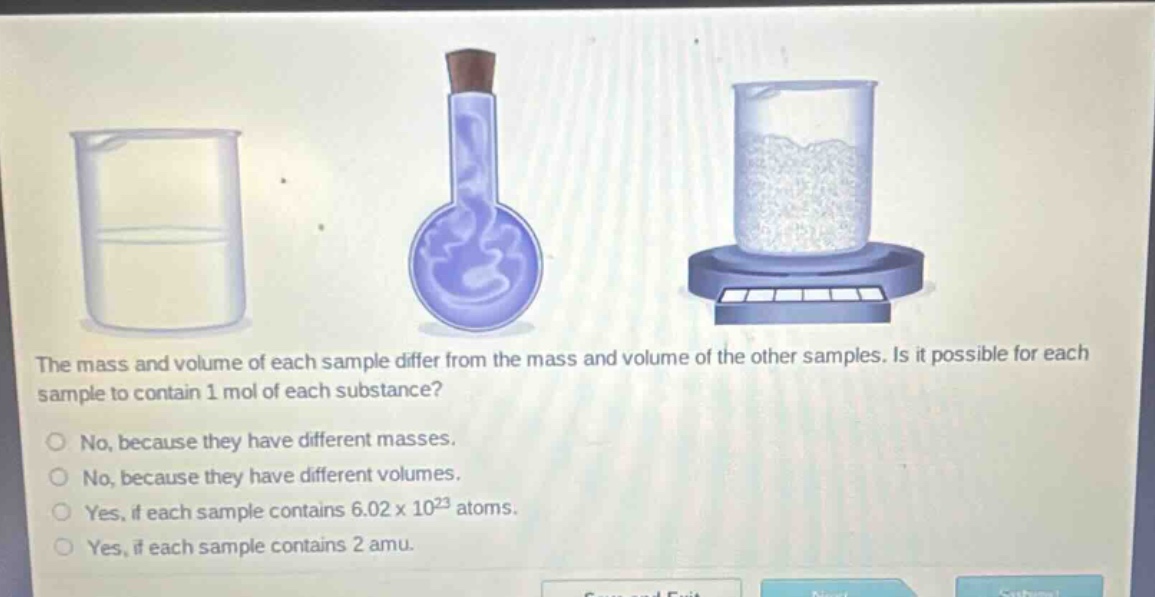
the mass and volume of each sample differ from the mass and volume of the other samples. is it possible for each sample to contain 1 mol of each substance?\nno, because they have different masses.\nno, because they have different volumes.\nyes, if each sample contains 6.02 x 10^23 atoms.\nyes, if each sample contains 2 amu.
Answer
Explanation:
Step1: Recall mole concept
One mole of any substance contains Avogadro's number of particles, which is $6.02\times 10^{23}$ particles. These particles can be atoms, molecules etc. The mass and volume of one - mole samples of different substances can vary because different substances have different molar masses and densities.
Step2: Analyze options
- Option 1: Different masses do not mean they can't be 1 - mole samples as molar mass varies for different substances.
- Option 2: Different volumes also do not rule out the possibility of being 1 - mole samples as density varies.
- Option 3: If each sample contains $6.02\times 10^{23}$ atoms (or molecules depending on the substance), then each sample contains 1 mole of the substance. This is correct according to the definition of a mole.
- Option 4: 2 amu is not related to the definition of a mole. One mole of a substance has a mass in grams equal to its molar mass (in amu) and contains $6.02\times 10^{23}$ particles.
Answer:
Yes, if each sample contains $6.02\times 10^{23}$ atoms.