match each set of quantum numbers to the correct subshell description by typing in the correct number.\n1: n…
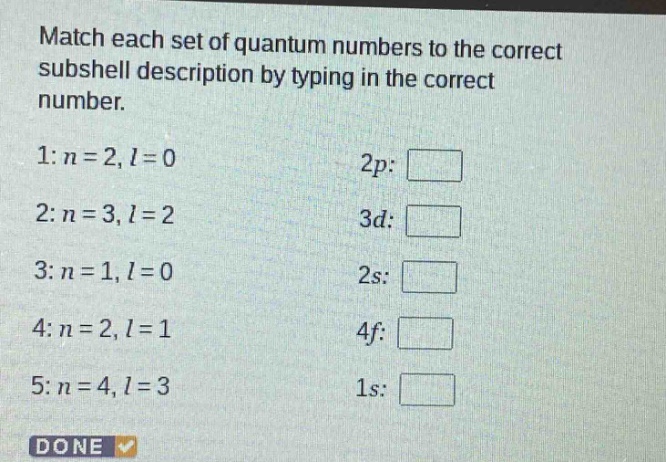
match each set of quantum numbers to the correct subshell description by typing in the correct number.\n1: n = 2, l = 0 2p: \n2: n = 3, l = 2 3d: \n3: n = 1, l = 0 2s: \n4: n = 2, l = 1 4f: \n5: n = 4, l = 3 1s: \ndone
Answer
Explanation:
Step1: Recall quantum - number rules
The principal quantum number $n$ represents the energy level, and the angular - momentum quantum number $l$ determines the subshell type ($l = 0$ is an $s$ - subshell, $l=1$ is a $p$ - subshell, $l = 2$ is a $d$ - subshell, $l=3$ is an $f$ - subshell).
Step2: Match $n = 2$, $l = 0$
Since $l = 0$ is an $s$ - subshell and $n = 2$, it is the $2s$ subshell. So, for $2s$, the number is 1.
Step3: Match $n = 3$, $l = 2$
Since $l = 2$ is a $d$ - subshell and $n = 3$, it is the $3d$ subshell. So, for $3d$, the number is 2.
Step4: Match $n = 1$, $l = 0$
Since $l = 0$ is an $s$ - subshell and $n = 1$, it is the $1s$ subshell. So, for $1s$, the number is 3.
Step5: Match $n = 2$, $l = 1$
Since $l = 1$ is a $p$ - subshell and $n = 2$, it is the $2p$ subshell. So, for $2p$, the number is 4.
Step6: Match $n = 4$, $l = 3$
Since $l = 3$ is an $f$ - subshell and $n = 4$, it is the $4f$ subshell. So, for $4f$, the number is 5.
Answer:
2p: 4 3d: 2 2s: 1 4f: 5 1s: 3