ming has two unknown substances. one is nonpolar, and the other is polar. which process would most likely…
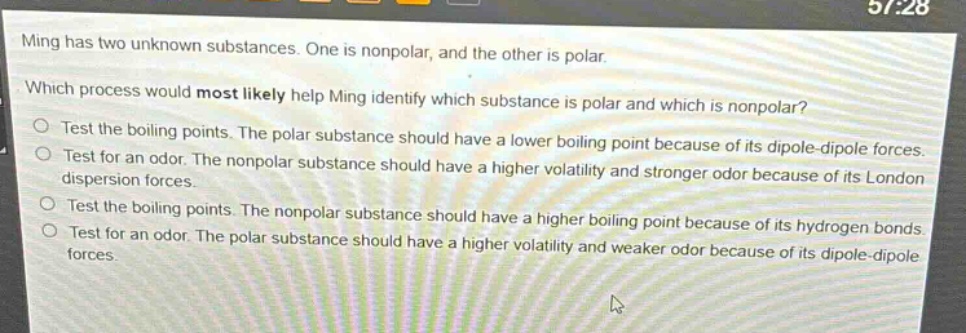
ming has two unknown substances. one is nonpolar, and the other is polar. which process would most likely help ming identify which substance is polar and which is nonpolar? test the boiling points. the polar substance should have a lower boiling point because of its dipole - dipole forces. test for an odor. the nonpolar substance should have a higher volatility and stronger odor because of its london dispersion forces. test the boiling points. the nonpolar substance should have a higher boiling point because of its hydrogen bonds. test for an odor. the polar substance should have a higher volatility and weaker odor because of its dipole - dipole forces.
Answer
Answer:
Test the boiling points. The polar substance should have a higher boiling point because of its hydrogen bonds.
Explanation:
Step1: Understand intermolecular forces
Polar substances have dipole - dipole forces and can have hydrogen bonds if they have H attached to N, O, or F. Non - polar substances have London dispersion forces.
Step2: Compare strength of forces
Hydrogen bonds and dipole - dipole forces are stronger than London dispersion forces.
Step3: Relate to boiling point
Stronger intermolecular forces require more energy to break, so substances with stronger forces have higher boiling points. Polar substances with hydrogen bonds or dipole - dipole forces have higher boiling points than non - polar substances with only London dispersion forces.