mole unit review problems\n1) what is a hydrated compound? how are hydrates named?\n2) write the formula for…
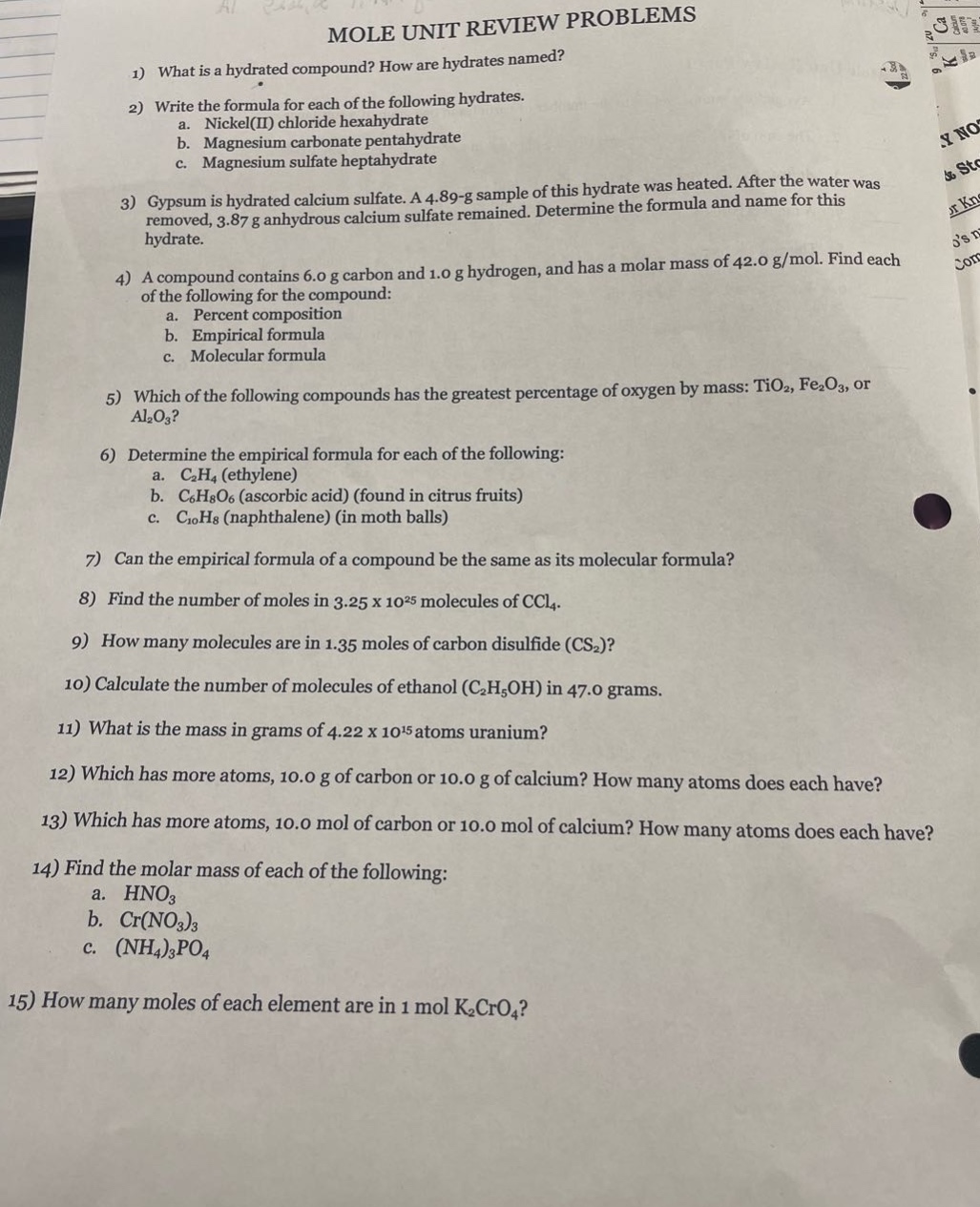
mole unit review problems\n1) what is a hydrated compound? how are hydrates named?\n2) write the formula for each of the following hydrates.\na. nickel(ii) chloride hexahydrate\nb. magnesium carbonate pentahydrate\nc. magnesium sulfate heptahydrate\n3) gypsum is hydrated calcium sulfate. a 4.89 - g sample of this hydrate was heated. after the water was removed, 3.87 g anhydrous calcium sulfate remained. determine the formula and name for this hydrate.\n4) a compound contains 6.0 g carbon and 1.0 g hydrogen, and has a molar mass of 42.0 g/mol. find each of the following for the compound:\na. percent composition\nb. empirical formula\nc. molecular formula\n5) which of the following compounds has the greatest percentage of oxygen by mass: tio₂, fe₂o₃, or al₂o₃?\n6) determine the empirical formula for each of the following:\na. c₂h₄ (ethylene)\nb. c₆h₈o₆ (ascorbic acid) (found in citrus fruits)\nc. c₁₀h₈ (naphthalene) (in moth balls)\n7) can the empirical formula of a compound be the same as its molecular formula?\n8) find the number of moles in 3.25 x 10²⁵ molecules of ccl₄.\n9) how many molecules are in 1.35 moles of carbon disulfide (cs₂)?\n10) calculate the number of molecules of ethanol (c₂h₅oh) in 47.0 grams.\n11) what is the mass in grams of 4.22 x 10¹⁵ atoms uranium?\n12) which has more atoms, 10.0 g of carbon or 10.0 g of calcium? how many atoms does each have?\n13) which has more atoms, 10.0 mol of carbon or 10.0 mol of calcium? how many atoms does each have?\n14) find the molar mass of each of the following:\na. hno₃\nb. cr(no₃)₃\nc. (nh₄)₃po₄\n15) how many moles of each element are in 1 mol k₂cro₄?
Answer
Explanation:
Step1: Define hydrated compound
A hydrated compound is a compound that contains water molecules within its crystal structure.
Step2: Explain naming of hydrates
Hydrates are named by first naming the anhydrous (without - water) compound and then using a prefix (mono - for 1, di - for 2, tri - for 3, etc.) followed by "hydrate" to indicate the number of water molecules per formula unit of the anhydrous compound.
Answer: A hydrated compound contains water molecules in its crystal structure. Hydrates are named by naming the anhydrous compound first and then using a prefix to indicate the number of water molecules followed by "hydrate".
Explanation:
Step1: For nickel(II) chloride hexahydrate
The formula of nickel(II) chloride is $NiCl_2$ and "hexahydrate" means 6 water molecules. So the formula is $NiCl_2\cdot6H_2O$.
Step2: For magnesium carbonate pentahydrate
The formula of magnesium carbonate is $MgCO_3$ and "pentahydrate" means 5 water molecules. So the formula is $MgCO_3\cdot5H_2O$.
Step3: For magnesium sulfate heptahydrate
The formula of magnesium sulfate is $MgSO_4$ and "heptahydrate" means 7 water molecules. So the formula is $MgSO_4\cdot7H_2O$.
Answer:
a. $NiCl_2\cdot6H_2O$ b. $MgCO_3\cdot5H_2O$ c. $MgSO_4\cdot7H_2O$
Explanation:
Step1: Calculate mass of water
Mass of water = Mass of hydrate - Mass of anhydrous salt. So, mass of water $m = 4.89 - 3.87=1.02$ g.
Step2: Calculate moles of water and anhydrous salt
Molar mass of water $H_2O$ is $M_{H_2O}=18.015$ g/mol, moles of water $n_{H_2O}=\frac{1.02}{18.015}\approx0.0566$ mol. Molar mass of $CaSO_4$ is $M_{CaSO_4}=136.14$ g/mol, moles of $CaSO_4$ $n_{CaSO_4}=\frac{3.87}{136.14}\approx0.0284$ mol.
Step3: Find the ratio of water to anhydrous salt
Ratio $\frac{n_{H_2O}}{n_{CaSO_4}}=\frac{0.0566}{0.0284}\approx2$. The formula is $CaSO_4\cdot2H_2O$, named calcium sulfate dihydrate.
Answer: The formula is $CaSO_4\cdot2H_2O$, named calcium sulfate dihydrate.
Explanation:
Step1: Calculate percent composition
Total mass of sample $m = 6.0 + 1.0=7.0$ g. Percent of carbon $=\frac{6.0}{7.0}\times100%\approx85.7%$, percent of hydrogen $=\frac{1.0}{7.0}\times100%\approx14.3%$.
Step2: Calculate empirical formula
Moles of carbon $n_C=\frac{6.0}{12.01}\approx0.5$ mol, moles of hydrogen $n_H=\frac{1.0}{1.008}\approx1.0$ mol. The ratio of $C:H = 0.5:1 = 1:2$, empirical formula is $CH_2$.
Step3: Calculate molecular formula
Empirical - formula mass of $CH_2$ is $M_{emp}=12.01 + 2\times1.008 = 14.026$ g/mol. $n=\frac{M_{mol}}{M_{emp}}=\frac{42.0}{14.026}\approx3$. Molecular formula is $C_3H_6$.
Answer:
a. Percent composition: Carbon $\approx85.7%$, Hydrogen $\approx14.3%$ b. Empirical formula: $CH_2$ c. Molecular formula: $C_3H_6$
Explanation:
Step1: Calculate molar mass and mass of oxygen for each compound
For $TiO_2$: Molar mass $M_{TiO_2}=47.87+2\times16.00 = 79.87$ g/mol, mass of oxygen per mole $m_O = 32.00$ g, $%O=\frac{32.00}{79.87}\times100%\approx40.1%$. For $Fe_2O_3$: Molar mass $M_{Fe_2O_3}=2\times55.85 + 3\times16.00=159.7$ g/mol, mass of oxygen per mole $m_O = 48.00$ g, $%O=\frac{48.00}{159.7}\times100%\approx30.0%$. For $Al_2O_3$: Molar mass $M_{Al_2O_3}=2\times26.98+3\times16.00 = 101.96$ g/mol, mass of oxygen per mole $m_O = 48.00$ g, $%O=\frac{48.00}{101.96}\times100%\approx47.1%$.
Answer: $Al_2O_3$ has the greatest percentage of oxygen by mass.
Explanation:
Step1: For $C_2H_4$
Divide the sub - scripts by the greatest common divisor. For $C_2H_4$, the greatest common divisor of 2 and 4 is 2. The empirical formula is $CH_2$.
Step2: For $C_6H_8O_6$
The greatest common divisor of 6, 8 and 6 is 2. The empirical formula is $C_3H_4O_3$.
Step3: For $C_{10}H_8$
The greatest common divisor of 10 and 8 is 2. The empirical formula is $C_5H_4$.
Answer:
a. $CH_2$ b. $C_3H_4O_3$ c. $C_5H_4$
Explanation:
Yes, the empirical formula of a compound can be the same as its molecular formula when the ratio of atoms in the empirical formula is already the actual ratio in the molecule. For example, $H_2O$ has an empirical formula of $H_2O$ and a molecular formula of $H_2O$.
Answer: Yes
Explanation:
Step1: Use Avogadro's number
Avogadro's number $N_A = 6.022\times10^{23}$ molecules/mol. Moles $n=\frac{N}{N_A}$, where $N = 3.25\times10^{25}$ molecules. So $n=\frac{3.25\times10^{25}}{6.022\times10^{23}}\approx54.0$ mol.
Answer: Approximately 54.0 moles
Explanation:
Step1: Use Avogadro's number
Avogadro's number $N_A = 6.022\times10^{23}$ molecules/mol. Number of molecules $N=n\times N_A$, where $n = 1.35$ moles. So $N=1.35\times6.022\times10^{23}=8.13\times10^{23}$ molecules.
Answer: $8.13\times10^{23}$ molecules
Explanation:
Step1: Calculate molar mass of ethanol
Molar mass of $C_2H_5OH$: $M=(2\times12.01)+(6\times1.008)+16.00 = 46.07$ g/mol. Moles of ethanol $n=\frac{m}{M}=\frac{47.0}{46.07}\approx1.02$ mol.
Step2: Calculate number of molecules
Number of molecules $N=n\times N_A$, where $N_A = 6.022\times10^{23}$ molecules/mol. So $N = 1.02\times6.022\times10^{23}=6.14\times10^{23}$ molecules.
Answer: $6.14\times10^{23}$ molecules
Explanation:
Step1: Use Avogadro's number and molar mass of uranium
Molar mass of uranium $M_{U}=238.03$ g/mol, Avogadro's number $N_A = 6.022\times10^{23}$ atoms/mol. Moles of uranium $n=\frac{N}{N_A}=\frac{4.22\times10^{15}}{6.022\times10^{23}}\approx7.01\times10^{-9}$ mol. Mass $m=n\times M=(7.01\times10^{-9})\times238.03\approx1.67\times10^{-6}$ g.
Answer: Approximately $1.67\times10^{-6}$ g
Explanation:
Step1: Calculate moles of carbon and calcium
Molar mass of carbon $M_C = 12.01$ g/mol, moles of carbon $n_C=\frac{10.0}{12.01}\approx0.833$ mol. Molar mass of calcium $M_{Ca}=40.08$ g/mol, moles of calcium $n_{Ca}=\frac{10.0}{40.08}\approx0.249$ mol.
Step2: Calculate number of atoms using Avogadro's number
Number of carbon atoms $N_C=n_C\times N_A=0.833\times6.022\times10^{23}\approx5.02\times10^{23}$ atoms. Number of calcium atoms $N_{Ca}=n_{Ca}\times N_A=0.249\times6.022\times10^{23}\approx1.50\times10^{23}$ atoms. Carbon has more atoms.
Answer: Carbon has more atoms. Carbon has approximately $5.02\times10^{23}$ atoms and calcium has approximately $1.50\times10^{23}$ atoms.
Explanation:
Step1: Use Avogadro's number
1 mole of any substance contains $N_A = 6.022\times10^{23}$ atoms. For 10.0 mol of carbon, number of atoms $N_C=10.0\times6.022\times10^{23}=6.022\times10^{24}$ atoms. For 10.0 mol of calcium, number of atoms $N_{Ca}=10.0\times6.022\times10^{23}=6.022\times10^{24}$ atoms. They have the same number of atoms.
Answer: They have the same number of atoms. Each has $6.022\times10^{24}$ atoms.
Explanation:
Step1: For $HNO_3$
Molar mass $M=(1.008)+(14.01)+(3\times16.00)=63.02$ g/mol.
Step2: For $Cr(NO_3)_3$
Molar mass $M=(52.00)+3\times[(14.01)+(3\times16.00)]=238.01$ g/mol.
Step3: For $(NH_4)_3PO_4$
Molar mass $M = 3\times[(14.01)+(4\times1.008)]+(30.97)+(4\times16.00)=149.09$ g/mol.
Answer:
a. 63.02 g/mol b. 238.01 g/mol c. 149.09 g/mol
Explanation:
In 1 mol of $K_2CrO_4$, there are 2 moles of potassium ($K$), 1 mole of chromium ($Cr$) and 4 moles of oxygen ($O$).