for every 1 molecule of glucose (c₆h₁₂o₆) and 6 molecules of oxygen gas (o₂) that go into cellular…
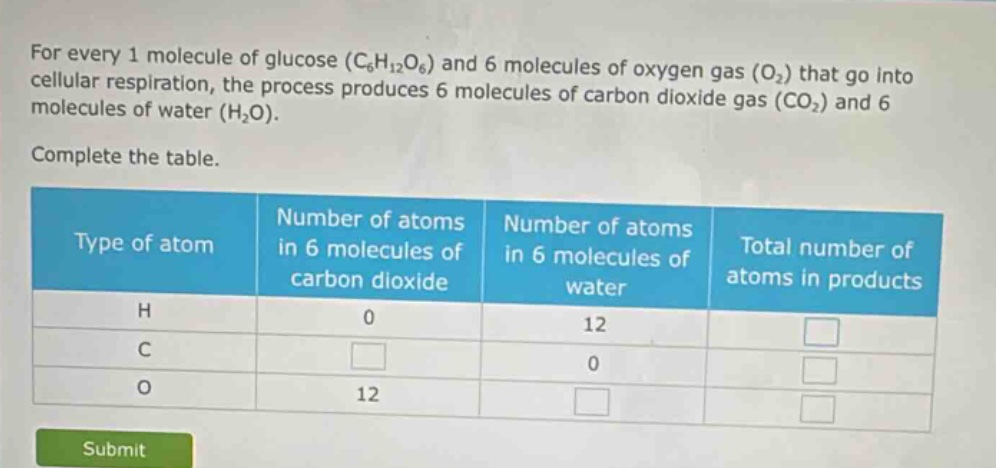
for every 1 molecule of glucose (c₆h₁₂o₆) and 6 molecules of oxygen gas (o₂) that go into cellular respiration, the process produces 6 molecules of carbon dioxide gas (co₂) and 6 molecules of water (h₂o).\ncomplete the table.\n| type of atom | number of atoms in 6 molecules of carbon dioxide | number of atoms in 6 molecules of water | total number of atoms in products |\n| ---- | ---- | ---- | ---- |\n| h | 0 | 12 | |\n| c | | 0 | |\n| o | 12 | | |\nsubmit
Answer
Explanation:
Step1: Calculate H - atoms in products
Each water molecule ($H_2O$) has 2 hydrogen atoms. So in 6 molecules of water, the number of hydrogen atoms is $2\times6 = 12$. Since there are no hydrogen atoms in carbon - dioxide ($CO_2$), the total number of hydrogen atoms in products is 12.
Step2: Calculate C - atoms in 6 molecules of $CO_2$
Each carbon - dioxide molecule ($CO_2$) has 1 carbon atom. So in 6 molecules of carbon - dioxide, the number of carbon atoms is $1\times6=6$. Since there are no carbon atoms in water ($H_2O$), the total number of carbon atoms in products is 6.
Step3: Calculate O - atoms in 6 molecules of water
Each water molecule ($H_2O$) has 1 oxygen atom. So in 6 molecules of water, the number of oxygen atoms is $1\times6 = 6$.
Step4: Calculate total O - atoms in products
The number of oxygen atoms in 6 molecules of carbon - dioxide is 12 and in 6 molecules of water is 6. So the total number of oxygen atoms in products is $12 + 6=18$.
Answer:
| Type of atom | Number of atoms in 6 molecules of carbon dioxide | Number of atoms in 6 molecules of water | Total number of atoms in products |
|---|---|---|---|
| H | 0 | 12 | 12 |
| C | 6 | 0 | 6 |
| O | 12 | 6 | 18 |