nitrogen dioxide, no2(g) (δhf = 33.84 kj/mol), is decomposed according to the following reaction: 2no2(g) →…
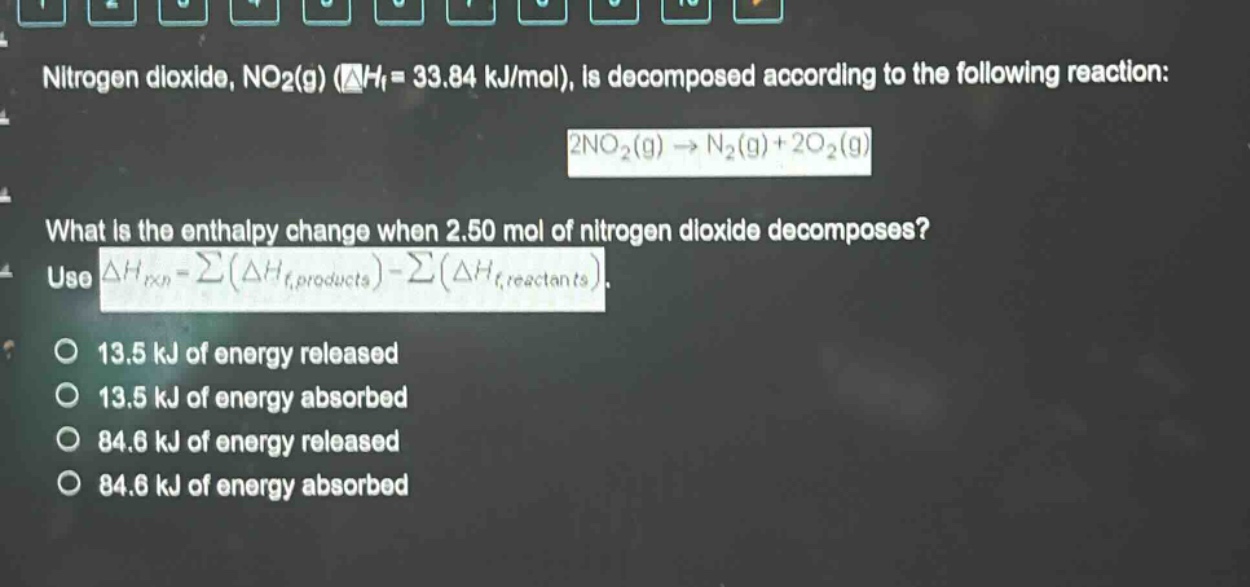
nitrogen dioxide, no2(g) (δhf = 33.84 kj/mol), is decomposed according to the following reaction: 2no2(g) → n2(g)+2o2(g) what is the enthalpy change when 2.50 mol of nitrogen dioxide decomposes? use δhrxn = σ(δhf,products) - σ(δhf,reactants). 13.5 kj of energy released 13.5 kj of energy absorbed 84.6 kj of energy released 84.6 kj of energy absorbed
Answer
Explanation:
Step1: Determine $\Delta H_f$ values for products
The standard - enthalpy of formation of $N_2(g)$ is $\Delta H_f(N_2)=0$ kJ/mol and for $O_2(g)$ is $\Delta H_f(O_2)=0$ kJ/mol.
Step2: Calculate $\sum(\Delta H_{f,products})$
For the reaction $2NO_2(g)\rightarrow N_2(g) + 2O_2(g)$, $\sum(\Delta H_{f,products})=\Delta H_f(N_2)+2\Delta H_f(O_2)=0 + 2\times0=0$ kJ/mol.
Step3: Calculate $\sum(\Delta H_{f,reactants})$
The $\Delta H_f$ for $NO_2$ is given as $\Delta H_f(NO_2)=33.84$ kJ/mol. For 2 moles of $NO_2$, $\sum(\Delta H_{f,reactants}) = 2\times\Delta H_f(NO_2)=2\times33.84 = 67.68$ kJ/mol.
Step4: Calculate $\Delta H_{rxn}$
Using the formula $\Delta H_{rxn}=\sum(\Delta H_{f,products})-\sum(\Delta H_{f,reactants})$, we get $\Delta H_{rxn}=0 - 67.68=- 67.68$ kJ for the reaction of 2 moles of $NO_2$.
Step5: Calculate $\Delta H$ for 2.50 mol of $NO_2$
Set up a proportion. If for 2 moles $\Delta H=-67.68$ kJ, for 2.50 moles, $\Delta H=\frac{2.50}{2}\times67.68 = 84.6$ kJ. Since $\Delta H>0$, energy is absorbed.
Answer:
84.6 kJ of energy absorbed