which orbital diagram correctly represents fluorine (atomic number 9)?
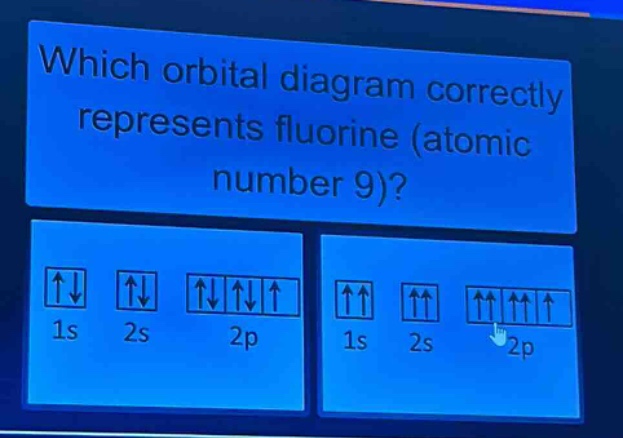
which orbital diagram correctly represents fluorine (atomic number 9)?
Answer
Explanation:
Step1: Determine the electron configuration of fluorine
Fluorine has an atomic number of 9, so it has 9 electrons. The electron configuration is (1s^{2}2s^{2}2p^{5}).
Step2: Analyze the orbital filling rules
According to Hund's rule, electrons fill degenerate orbitals (same - energy orbitals) singly first before pairing up. For the (2p) orbitals (three degenerate (p) orbitals), we first fill each (p) orbital with one electron (parallel spins) and then start pairing. For the left - hand diagram:
- In the (1s) orbital: (2) electrons (paired, which is correct as per Pauli exclusion principle).
- In the (2s) orbital: (2) electrons (paired, correct).
- In the (2p) orbitals: There are three (p) orbitals. The first two (p) orbitals have two pairs of electrons ((4) electrons) and the third (p) orbital has one electron. This follows the electron configuration (1s^{2}2s^{2}2p^{5}) (since (2 + 2+4 + 1=9)) and Hund's rule (pairing starts after filling orbitals singly as much as possible). For the right - hand diagram:
- In the (1s) orbital: The electrons are not paired (violates Pauli exclusion principle which states that in an orbital, electrons must have opposite spins).
- In the (2s) orbital: The electrons are not paired (violates Pauli exclusion principle).
Answer:
The left - hand orbital diagram.