which of these is an oxidation half - reaction?\nv^{3+}+e^{-}\to v^{2+}\nfe\to fe^{3+}+3e^{-}\nc^{4+}+2e^{-}\…
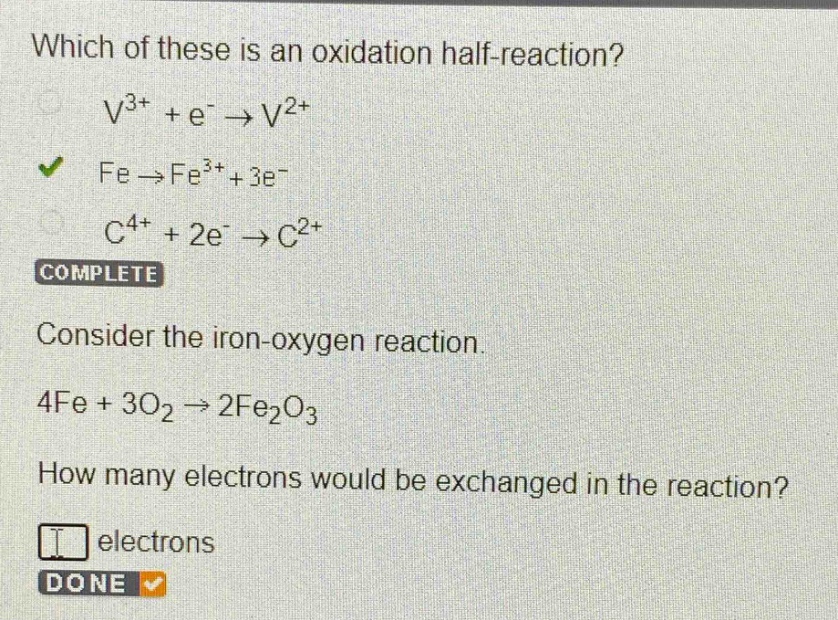
which of these is an oxidation half - reaction?\nv^{3+}+e^{-}\to v^{2+}\nfe\to fe^{3+}+3e^{-}\nc^{4+}+2e^{-}\to c^{2+}\ncomplete\nconsider the iron - oxygen reaction.\n4fe + 3o_{2}\to 2fe_{2}o_{3}\nhow many electrons would be exchanged in the reaction?\nelectrons\ndone
Answer
Answer:
12
Explanation:
Step1: Analyze iron's oxidation state change
In $Fe$, oxidation state is 0. In $Fe_2O_3$, iron has oxidation state +3. Each Fe atom loses 3 electrons.
Step2: Determine number of Fe atoms
There are 4 Fe atoms in the reactant side of $4Fe + 3O_2\rightarrow2Fe_2O_3$.
Step3: Calculate total electrons exchanged
Since each Fe atom loses 3 electrons and there are 4 Fe atoms, total electrons exchanged is $4\times3 = 12$.