for each pair of gases, select the one that most likely has the highest rate of effusion. use the periodic…
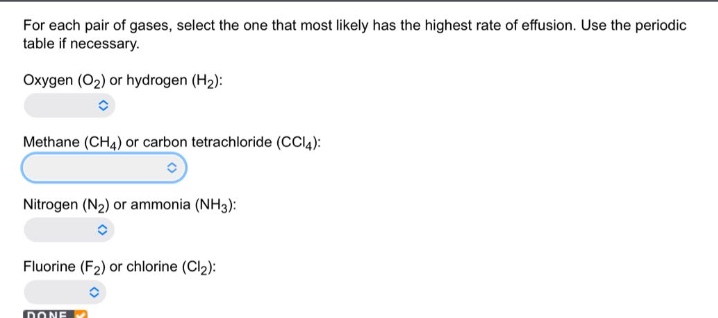
for each pair of gases, select the one that most likely has the highest rate of effusion. use the periodic table if necessary.\noxygen (o₂) or hydrogen (h₂):\nmethane (ch₄) or carbon tetrachloride (ccl₄):\nnitrogen (n₂) or ammonia (nh₃):\nfluorine (f₂) or chlorine (cl₂):
Answer
Explanation:
Step1: Recall Graham's law of effusion
According to Graham's law of effusion, the rate of effusion of a gas is inversely proportional to the square - root of its molar mass ($r\propto\frac{1}{\sqrt{M}}$), where $r$ is the rate of effusion and $M$ is the molar mass. So, the gas with the lower molar mass will have a higher rate of effusion.
Step2: Calculate molar masses and compare for oxygen and hydrogen
The molar mass of $O_2$: $M_{O_2}=2\times16.00\ g/mol = 32.00\ g/mol$. The molar mass of $H_2$: $M_{H_2}=2\times1.01\ g/mol=2.02\ g/mol$. Since $M_{H_2}<M_{O_2}$, hydrogen ($H_2$) has a higher rate of effusion.
Step3: Calculate molar masses and compare for methane and carbon - tetrachloride
The molar mass of $CH_4$: $M_{CH_4}=12.01 + 4\times1.01=16.05\ g/mol$. The molar mass of $CCl_4$: $M_{CCl_4}=12.01+4\times35.45 = 153.81\ g/mol$. Since $M_{CH_4}<M_{CCl_4}$, methane ($CH_4$) has a higher rate of effusion.
Step4: Calculate molar masses and compare for nitrogen and ammonia
The molar mass of $N_2$: $M_{N_2}=2\times14.01\ g/mol = 28.02\ g/mol$. The molar mass of $NH_3$: $M_{NH_3}=14.01+3\times1.01 = 17.04\ g/mol$. Since $M_{NH_3}<M_{N_2}$, ammonia ($NH_3$) has a higher rate of effusion.
Step5: Calculate molar masses and compare for fluorine and chlorine
The molar mass of $F_2$: $M_{F_2}=2\times19.00\ g/mol = 38.00\ g/mol$. The molar mass of $Cl_2$: $M_{Cl_2}=2\times35.45\ g/mol = 70.90\ g/mol$. Since $M_{F_2}<M_{Cl_2}$, fluorine ($F_2$) has a higher rate of effusion.
Answer:
Oxygen ($O_2$) or hydrogen ($H_2$): Hydrogen ($H_2$) Methane ($CH_4$) or carbon tetrachloride ($CCl_4$): Methane ($CH_4$) Nitrogen ($N_2$) or ammonia ($NH_3$): Ammonia ($NH_3$) Fluorine ($F_2$) or chlorine ($Cl_2$): Fluorine ($F_2$)