which pairs of elements do not have to satisfy the octet rule for stability?\no potassium (k) and sodium…
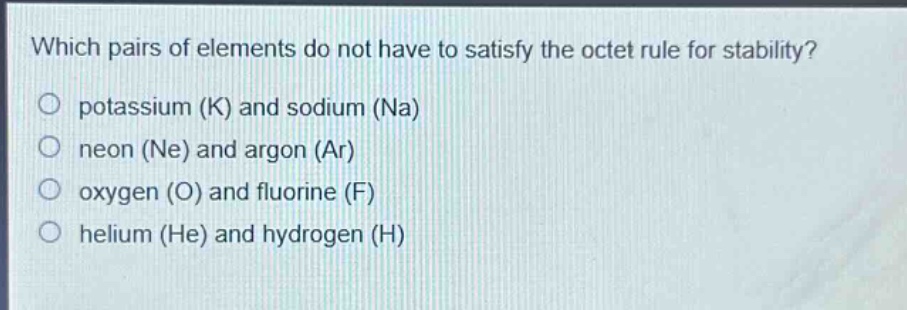
which pairs of elements do not have to satisfy the octet rule for stability?\no potassium (k) and sodium (na)\no neon (ne) and argon (ar)\no oxygen (o) and fluorine (f)\no helium (he) and hydrogen (h)
Answer
Answer:
D. helium (He) and hydrogen (H)
Explanation:
Step1: Understand the octet rule
The octet rule states that atoms tend to gain, lose, or share electrons to have 8 electrons in their outer - most shell for stability.
Step2: Analyze each option
- Option A: Potassium (K) and sodium (Na) are metals and follow the octet rule by losing electrons to achieve a stable noble - gas configuration.
- Option B: Neon (Ne) and argon (Ar) are noble gases and already have a full outer shell of 8 electrons (octet), following the octet rule.
- Option C: Oxygen (O) and fluorine (F) form compounds to achieve an octet of electrons in their outer shell.
- Option D: Helium (He) has only 2 electrons in its outer shell and is stable with a duet. Hydrogen (H) is stable with 2 electrons in its outer shell (duet) and does not follow the octet rule.